
A running toilet sounds minor. The water is still flushing, the bowl refills, and aside from the low hiss coming from the tank, nothing seems obviously broken. Most Phoenix homeowners live with it for weeks before getting around to a fix.
That patience gets expensive. A toilet that runs continuously can waste 200 gallons of water per day, which turns into thousands of gallons a month and a water bill spike nobody wants in the middle of a desert summer. The good news is that most running-toilet problems have the same handful of causes, and almost all of them are fixable in under an hour.
This guide walks through why toilets run, how to identify which part is failing, and how to fix the issue yourself or decide when to bring in a professional.
How a Toilet Tank Actually Works
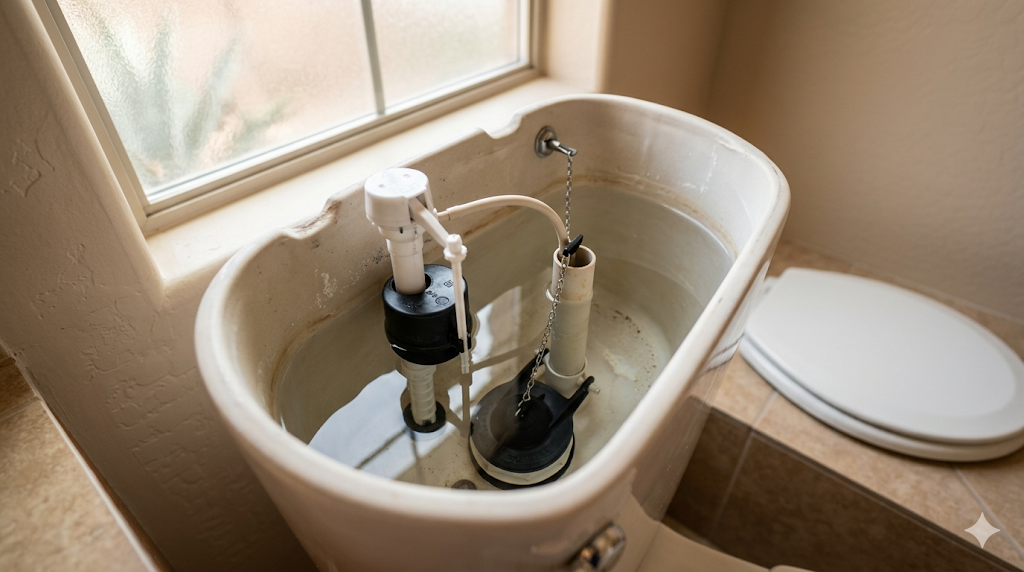
Understanding the fix starts with understanding the mechanism. A standard gravity-flush toilet has a simple setup inside the tank:
- The flapper is the rubber seal at the bottom of the tank. It lifts when you press the handle, releases water into the bowl, and drops back into place once the tank empties.
- The fill valve is the tall assembly on the left side of the tank. It refills the tank after a flush and shuts off when the water reaches the correct level.
- The float rises with the water and tells the fill valve when to shut off. Older toilets use a ball float on an arm; newer models use a cup float that slides up and down the fill valve shaft.
- The overflow tube is the vertical pipe in the middle of the tank. If the water level gets too high, water spills into the overflow tube and drains into the bowl instead of onto the floor.
A running toilet is always caused by one of these components failing to do its job. The water keeps flowing because either the flapper isn’t sealing, the fill valve isn’t shutting off, or the water level is set too high and spilling into the overflow tube.
6 Reasons Your Toilet Keeps Running

1. Worn or Warped Flapper
The most common cause by a wide margin. Flappers are rubber, and rubber degrades. Over 3 to 5 years, flappers harden, warp, crack, or develop mineral deposits that prevent them from sealing against the flush valve seat. Phoenix’s hard water accelerates this dramatically. Mineral scale builds up on both the flapper and the seat, and the seal breaks down years earlier than it would in a soft-water region.
When the flapper doesn’t seal, water slowly leaks from the tank into the bowl. The fill valve senses the dropping water level and kicks on to refill, usually in brief cycles every few minutes. This is often called a “phantom flush” because the toilet seems to flush itself randomly.
The fix is usually a new flapper, which costs under $15 at any hardware store. Our guide on how to change your toilet flapper walks through the replacement step by step.
2. Flapper Chain Too Short or Tangled
The chain connecting the flush handle to the flapper needs just enough slack to let the flapper drop back into place after a flush. If the chain is too short, it holds the flapper slightly open and water runs continuously. If the chain is too long, it can tangle under the flapper and prop it open.
Check the chain first. It should have about half an inch of slack when the flapper is seated. Adjust the length by moving the hook to a different link.
3. Misaligned or Broken Flush Valve Seat
The flush valve seat is the plastic or brass ring that the flapper seals against. Mineral buildup, corrosion, or a crack in the seat creates gaps that no flapper can seal, regardless of how new the flapper is. If you’ve replaced the flapper and the toilet still runs, inspect the seat.
Feel the top of the seat with your finger while the tank is empty. It should be smooth. Pits, roughness, or visible mineral crust are signs the seat needs cleaning or replacement. A flush valve seat repair kit adds a flat gasket over a damaged seat and often solves the problem without replacing the entire valve.
4. Fill Valve Not Shutting Off
If water keeps flowing into the tank and spilling into the overflow tube, the fill valve is the issue. Fill valves typically last 5 to 10 years before the internal seals wear out or mineral buildup prevents them from closing fully.
Signs of a bad fill valve include:
- Water visibly spilling into the overflow tube when the tank is full
- The valve hisses constantly even after the tank refills
- The tank refills too slowly or never fully fills
- Water level in the tank is above the marked fill line
Fill valves are inexpensive ($15 to $25) and replacement is a straightforward DIY project. Shut off the water supply under the toilet, flush to empty the tank, disconnect the supply line, unscrew the old valve, install the new one, reconnect, and turn the water back on.
5. Float Set Too High
If the water level is set too high, water constantly spills into the overflow tube and the fill valve runs continuously trying to maintain that level.
On a ball-float setup, bend the float arm gently downward, or adjust the screw where the arm connects to the valve, to lower the shutoff point. On a cup-float setup, pinch the adjustment clip on the side of the float and slide it down the valve shaft. The correct water level is usually marked on the overflow tube or on the inside of the tank. It should sit about an inch below the top of the overflow.
6. Hard Water Damage to Multiple Components
Phoenix homes face a unique challenge: hard water damages every rubber and plastic component inside a toilet tank simultaneously. Flappers crack, fill valve diaphragms stiffen, and mineral scale coats every surface. If your toilet is more than 10 years old and it’s “always something” with the tank, the real fix is often replacing all the internal components at once, or in some cases replacing the entire toilet.
A whole-house water softener installation dramatically slows this deterioration. Homeowners with soft water typically get 8 to 10+ years out of toilet internals instead of 3 to 5.
How to Diagnose Your Running Toilet in Under 5 Minutes
This sequence identifies the cause quickly:
1. Listen. A continuous hiss usually means the fill valve isn’t shutting off. Periodic cycling (refills every few minutes with silence in between) usually means a leaking flapper.
2. Remove the tank lid. Watch the water during a refill cycle.
3. Check the water level. Is water spilling into the overflow tube when the tank appears full? Float is set too high or fill valve is stuck open.
4. Check the flapper. Press down gently on the flapper when the tank is full. If the fill valve kicks on shortly afterward, the flapper is leaking. You can also add a few drops of food coloring to the tank. Don’t flush. Wait 15 minutes. If color appears in the bowl, the flapper is leaking.
5. Check the chain. Is it tangled, too short, or caught under the flapper?
6. Inspect the flush valve seat. Run your finger around the top. Smooth means fine. Rough or crusted means damaged or scaled.
That five-step check identifies the problem in roughly 95% of running toilets.
What a Running Toilet Actually Costs

Water waste from a running toilet ranges from minor to severe depending on the failure:
- A slow flapper leak wastes 20 to 30 gallons per day
- A moderate leak (cycling fill valve every few minutes) wastes 70 to 100 gallons per day
- A continuously running toilet wastes 200 gallons per day or more
On Phoenix water rates, that translates to roughly $30 to $200 per month in wasted water, depending on severity. Over a year, ignored running toilets routinely cost homeowners $500 to $2,000+. The $15 flapper replacement looks pretty attractive in that context.
When to Call a Professional
Most running-toilet fixes are DIY friendly. A few situations warrant professional plumbing repair:
- You’ve replaced the flapper, the seat, and the fill valve, and it still runs
- The toilet rocks, leaks at the base, or has stained the floor around it
- Multiple toilets in the house are running simultaneously (possible water pressure issue)
- The fill valve replacement revealed corroded supply stops or damaged pipes
- The toilet is over 20 years old, has persistent issues, and you’re considering replacement
For aging toilets, plumbing installation of a modern high-efficiency model saves water, eliminates the constant repair cycle, and often qualifies for utility rebates.
Is the Running Toilet Hiding a Bigger Problem?
Occasionally, a running toilet is a symptom of something beyond the tank. Signs that point to a deeper issue:
- Water stains on the ceiling below an upstairs bathroom (supply line leak)
- Water pooling around the base of the toilet (wax ring or flange issue)
- Low water pressure throughout the house combined with slow toilet refills
- Sewer odors coming from the toilet even when not in use
Any of these warrant a full leak detection evaluation rather than just a flapper swap. The earlier a hidden leak is found, the less damage it causes to subfloors, drywall, and flooring.
Preventing Future Running-Toilet Problems
A few simple habits extend the life of toilet internals in Phoenix’s hard water:
Replace flappers proactively every 3 to 5 years. It’s cheap insurance and prevents the slow waste that otherwise goes unnoticed. Avoid drop-in tablet bleach cleaners (the blue or blue-green tablets that sit in the tank). They destroy flappers and other rubber components within months. Stick to in-bowl cleaners. Consider a water softener for whole-house protection against hard water damage, not just to toilets but to water heaters, faucets, and shower fixtures. Our Phoenix hard water guide explains the broader impact. Check toilets annually with the food-coloring test. Five minutes of diagnostic work catches small leaks before the water bill does.
Call Penguin Air When Your Toilet Won’t Stop Running
A running toilet quietly burns through water and money every day it’s ignored. If DIY fixes aren’t solving it or you’re tired of chasing the same repair every couple of years, call Penguin Air, Plumbing & Electrical at (480) 525-5400 for expert plumbing service anywhere in the Phoenix metro area. We’ll diagnose the real cause, fix it right, and help you prevent the next one.
Frequently Asked Questions
How much water does a running toilet waste?
Anywhere from 20 to 200+ gallons per day depending on the severity of the failure. A continuously running toilet can waste 6,000+ gallons per month, which adds up to hundreds of dollars on a Phoenix water bill.
Will a running toilet eventually stop on its own?
No. The mechanism is either failing or already failed. It will continue to run (and waste water) until a component is replaced.
Why does my toilet randomly refill itself at night?
This is called a phantom flush. It’s caused by a flapper that leaks slowly enough that the tank takes hours to drop below the fill valve threshold. When it finally does, the fill valve kicks on briefly to top off the tank. The fix is almost always a new flapper.
Can I ignore a running toilet if it’s just a little bit?
The wasted water adds up quickly, and small leaks always get bigger as the component continues to degrade. Fixing it promptly saves money and prevents a minor problem from becoming an inconvenient middle-of-the-night replacement job.
Why does my new flapper still leak?
The flush valve seat is probably damaged or coated in hard-water scale. Even a brand-new flapper can’t seal against a pitted or crusted seat. A seat repair kit or full flush valve replacement usually solves it.
How long should a toilet last in Phoenix?
Toilet bowls and tanks last 30 to 50 years. Internal components (flappers, fill valves, seats) last 3 to 10 years depending on water hardness. Phoenix’s hard water shortens that window significantly, so expect more frequent internal repairs here than in soft-water regions.
About Penguin Air
Penguin Air, Plumbing & Electrical has served Phoenix metro homeowners for decades with expert plumbing diagnosis, repair, and installation. Our licensed plumbers handle everything from quick toilet repairs to full bathroom renovations, with deep experience in the hard-water issues that affect every home in the Valley.