
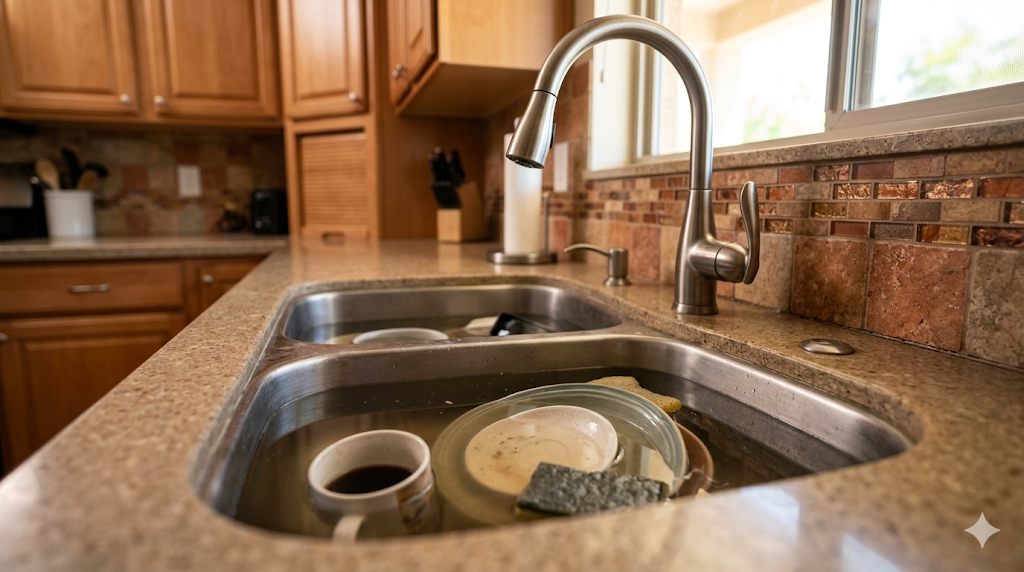
A kitchen sink that won’t drain is one of the most disruptive household plumbing problems. It stops cooking, washing dishes, and daily cleanup all at once. Worse, a clog that seems minor today almost always gets worse fast, because every meal prep, coffee pour, and dish rinse adds to whatever is blocking the line.
Most kitchen sink clogs are fixable without major plumbing work. A few are symptoms of something deeper in the drain system. This guide covers why kitchen drains clog, how to clear a blockage safely, what to avoid, and how to keep it from happening again.
Why Kitchen Sinks Clog Differently Than Other Drains
Bathroom sinks clog with hair and soap. Kitchen sinks deal with a tougher lineup: cooking grease, food particles, coffee grounds, and mineral scale from Phoenix’s exceptionally hard water. Those materials combine in ways that create unusually stubborn blockages.
Grease poured down the drain as a warm liquid cools and solidifies inside the pipe, coating the walls. Food particles stick to that grease layer. Mineral deposits from hard water build up on top of everything. What starts as an invisible film gradually narrows the pipe until one final coffee filter or pasta-water drain pushes it past the point of flow.
Phoenix’s water is among the hardest in the country, with calcium and magnesium levels that accelerate scale buildup inside drain lines far faster than in most cities. Our guide on Phoenix hard water covers the broader impact on plumbing systems.
7 Common Causes of a Clogged Kitchen Sink

1. Grease and Cooking Oil Buildup
The number-one cause. Every fat molecule that goes down a kitchen drain eventually sticks somewhere. Bacon grease, cooking oil, butter, salad dressing, dairy residue from rinsed plates: it all accumulates. The fix that every plumber recommends is to never pour grease down the drain in the first place. Pour it into a can or jar, let it solidify, and throw it in the trash. Wipe greasy pans with a paper towel before rinsing.
2. Food Particles
Even with a disposal, small food particles accumulate in the P-trap and horizontal drain sections. Rice, pasta, and oatmeal are particularly bad because they expand with water. Coffee grounds compact into dense plugs. Eggshells don’t sharpen blades (that myth needs to die), but they do break into small shards that bind with grease.
Scrape plates into the trash before rinsing, and run cold water with the disposal for a full 20 to 30 seconds after grinding to flush debris through the trap.
3. Mineral Scale from Hard Water
Calcium carbonate deposits build up inside drain pipes the same way they build up inside water heaters and on shower glass. In Phoenix, the scale layer can shrink a 1.5-inch drain line to under an inch of usable space within a decade. Scale doesn’t fully block a drain by itself, but it gives grease and food particles something to grab onto.
4. Garbage Disposal Issues
A disposal that’s jammed, dull, or simply undersized for what’s being fed into it pushes larger particles into the drain than the line can handle. Disposals aren’t magic: they grind food into smaller pieces, but those pieces still have to pass through the trap. Fibrous foods (celery, corn husks, artichoke leaves), starchy foods (potato peels, pasta), and oily foods (meat fat) are routine disposal killers.
5. Dishwasher Backup
In most Phoenix homes, the dishwasher drain line ties into the kitchen drain just below the sink, often through a high loop or air gap. When the kitchen sink clogs, dishwasher drainage backs up too, or vice versa. If your dishwasher is leaving standing water at the end of a cycle, the kitchen drain might be the actual problem.
6. P-Trap Blockage
The P-trap is the curved section of pipe directly under the sink. It holds a small volume of water to prevent sewer gas from entering the home, and it’s the most common spot for a hard clog to form. Silverware, bottle caps, toothpicks, and bread clips dropped into the disposal frequently wedge in the trap and catch everything that follows.
The P-trap is the easiest part of a kitchen drain to clear manually, and it’s where most DIY fixes begin. Details below.
7. Main Line Issues
Sometimes a “kitchen sink clog” is actually a problem further downstream. If sink drainage is slow and you also notice slow bathroom drains, gurgling toilets, or backups in lower-level fixtures, the blockage is in the main line, not the kitchen branch. Main-line clogs need professional drain clearing service and often a camera inspection to locate the source.
What to Try Before Calling a Plumber
Work through these steps in order. Most clogs clear in the first few.
Step 1: Boiling water. For a slow drain (not completely blocked), bring a kettle to a boil and pour it down the drain in three stages, waiting 30 seconds between each. This softens and flushes grease buildup. Skip this step if you have PVC drain lines that have already been weakened, or if you’ve recently poured chemical drain cleaner down the line.
Step 2: Plunger. A flat-bottomed sink plunger, not a toilet plunger, works on kitchen sinks. If you have a double sink, plug the unused basin tightly with a wet rag. Fill the clogged basin with a few inches of water to cover the plunger’s rim. Plunge with vigorous, straight up-and-down motion for 20 to 30 seconds.
Step 3: Baking soda and vinegar. Pour one cup of baking soda into the drain, followed by one cup of white vinegar. The reaction foams and helps loosen grease. Wait 10 minutes, then flush with a kettle of hot (not boiling) water. This is gentler than chemical cleaners and safer for pipes.
Step 4: Clean the P-trap. Place a bucket under the trap. Loosen the two slip nuts (by hand or with channel locks). Lower the trap, dump its contents into the bucket, and check for foreign objects. Rinse it out, check the short horizontal arm leading into the wall, and reassemble. Make sure the slip-nut washers are oriented correctly or the reassembled joint will leak.
Step 5: Drain snake. A handheld drum auger reaches further than a plunger and can break through tougher blockages. Feed the cable into the drain opening (or into the wall pipe with the trap removed) and crank slowly, extending the cable until you feel the obstruction. Work the cable back and forth, then retract. Run hot water to flush.
Our guide on DIY drain cleaning dos and don’ts goes deeper on these methods.
What Not to Do
Skip the liquid chemical drain cleaners. Products like Drano and Liquid-Plumr contain caustic ingredients that corrode older pipes, damage rubber gaskets, and generate heat that can warp PVC. They rarely clear a real clog and often turn a simple fix into an expensive one. If the chemical doesn’t clear the drain, a plumber now has to work with a line full of caustic liquid, which is dangerous and often means the drain needs to be replaced rather than repaired.
Don’t run the disposal repeatedly on a clogged drain. If water isn’t flowing through, grinding more food just packs the drain harder. Stop and diagnose before continuing to use the sink.
Don’t force a cable down a pipe. If you meet resistance with a snake, stop. Forcing can puncture older pipes or push the clog into a harder-to-reach section.
When to Call for Professional Drain Service

Some clogs don’t respond to DIY methods. Call for service when:
- Water backs up into both basins of a double sink (indicates the blockage is past the Y-connector)
- Other drains in the house are slow or gurgling
- The clog returns within days of clearing
- You smell sewer gas coming from the drain
- You’ve tried a plunger, trap cleaning, and snake with no progress
- The drain has been chemically treated and still isn’t clearing
A professional plumber has tools that go well beyond a consumer snake. Hydro jetting service uses high-pressure water to scour out grease and scale buildup along the entire pipe wall, not just punch a hole through it. For clogs that resist jetting, a camera inspection service can identify the exact location and cause, including collapsed pipe sections, root intrusion from landscaping, and scale buildup that needs replacement rather than clearing.
Preventing Future Kitchen Sink Clogs
A few habits dramatically reduce the odds of another clog:
Never pour grease down the drain. Run cold water with the disposal, not hot. Hot water melts grease and pushes it further into the line before it resolidifies. Cold water keeps it solid and lets the disposal grind it. Run the disposal for a full 20 to 30 seconds after the grinding sound changes, to make sure everything flushes through the trap. Once a month, flush the drain with hot water followed by a baking soda and vinegar treatment. Avoid putting fibrous, starchy, or oily foods through the disposal. If your home is 30+ years old with original galvanized drain lines, consider a whole-house plumbing evaluation. Galvanized pipes corrode from the inside and eventually need replacement regardless of clog-clearing efforts.
If the disposal itself is old, inefficient, or repeatedly causing issues, kitchen plumbing repair that includes a new disposal often eliminates recurring clog problems.
Call Penguin Air When Your Kitchen Sink Won’t Drain
A stubborn kitchen clog doesn’t have to derail your day. Call Penguin Air, Plumbing & Electrical at (480) 525-5400 for fast, professional drain service anywhere in the Phoenix metro area. We’ll clear the clog, identify why it happened, and help you prevent the next one.
Frequently Asked Questions
Why is my kitchen sink draining slowly but not completely blocked?
A slow drain means the line is partially clogged, usually with grease buildup narrowing the pipe. Address it now. Slow drains become complete blockages, often at the worst possible moment.
Can I use boiling water on PVC pipes?
In moderation, yes. Modern PVC drain lines are rated for temperatures well above boiling water for short periods. Don’t run boiling water through continuously for minutes at a time, but pouring a kettle down a drain won’t damage sound pipes.
Why does my kitchen sink clog repeatedly?
Recurring clogs usually indicate buildup further down the line that DIY methods aren’t reaching. A professional jetting service cleans the entire pipe wall rather than just punching a hole through the center of the blockage.
Is it safe to use Drano in my kitchen sink?
Not recommended. Chemical drain cleaners corrode pipe joints, damage gaskets, and often fail to clear real clogs. When they fail, they make professional service significantly more expensive and hazardous.
How much does professional drain cleaning cost in Phoenix?
Basic drain clearing typically runs $150 to $350. Hydro jetting is $400 to $800 depending on line length and accessibility. Camera inspections are usually $200 to $400 when not included in a service call.
Can hard water really cause drain clogs?
Indirectly, yes. The mineral scale inside drain lines doesn’t block water by itself, but it creates a rough surface that traps grease and food particles, accelerating the overall clog process. Whole-house water softening helps slow the scale buildup.
About Penguin Air
Penguin Air, Plumbing & Electrical has served Phoenix metro homeowners for decades with expert plumbing and drain service. Our technicians diagnose and clear kitchen sink clogs using tools that go well beyond consumer snakes, from hydro jetting to full pipe inspection with fiber-optic cameras. We fix the real problem rather than temporarily unblocking it.