
Is your Phoenix Valley water leaving white spots on every glass, crusty buildup on your faucets, and your skin feeling like sandpaper after a shower? You’re not imagining it. Phoenix has some of the hardest water in the country, and homeowners across the Valley deal with mineral scale damage every day. At Penguin Air, Plumbing & Electrical, we’ve been helping Phoenix homeowners tackle hard water since 2011, and a water softener is one of the smartest upgrades you can make. But do you actually need one? Let’s walk through it.
Ready to stop fighting hard water? Schedule online 24/7.
Key Takeaways
- Phoenix tap water averages 16+ grains per gallon, making it some of the hardest water in the United States.
- A water softener Phoenix homeowners install can extend the life of water heaters, dishwashers, and pipes by years.
- Signs you need one include scale buildup, dry skin, faded laundry, and rising energy bills from a stressed water heater.
- Salt-based softeners and salt-free conditioners work differently, so the right pick depends on your home and water use.
See that white crust building up around your faucets? The chalky film on the shower door that never quite wipes clean? Yeah, that’s hard water, and the Valley has some of the worst in the country. Scottsdale, Mesa, Tempe, Chandler, it’s all the same story once you live here past a season or two.
So do you actually need a water softener? Maybe. We’ve been installing and servicing them across the Valley since 2011, and the honest answer depends on your home, your water, and what’s driving you nuts. In this guide we’ll cover the real impact of hard water on your plumbing, salt-based vs salt-free systems, what installation looks like, and how to tell if it’s worth the spend.
Just How Hard Is Phoenix Water, and Why Does It Matter?

Short answer: Valley tap water is some of the hardest in the country. Most homes test between 200 and 300+ parts per million of dissolved minerals. The USGS calls anything above 180 ppm “very hard.” We are well past that line.
Phoenix Water Hardness by the Numbers
On the grains per gallon scale, most Valley homes land somewhere between 11 and 17 GPG. That puts hard water phoenix readings squarely in the “very hard to extremely hard” range. The main troublemakers are calcium and magnesium, with a little silica along for the ride.
Why so mineral-heavy? Two main sources feed the Valley: the Salt River Project and the Central Arizona Project. Both carry snowmelt that picks up minerals as it crosses desert geology on the way to your tap. By the time that water hits your kitchen sink in Mesa, Tempe, or Chandler, it is loaded.
What Hard Water Does to Your Plumbing Over Time
Limescale builds up inside your pipes, fixtures, and water heater tank. Hot water lines get hit hardest because heat makes minerals precipitate faster. That chalky white crust you see around faucets? Same thing is happening on the inside of your plumbing.
Inside a water heater, calcium settles to the bottom of the tank and forms a crusty layer over the burner or heating element. Your unit has to work harder to push heat through that layer. Energy bills creep up, recovery time slows, and the tank’s lifespan drops by years. If you have noticed a sluggish water heater or popping sounds from the tank, scale is usually the reason.
Scale also chews up dishwashers, washing machines, ice makers, and any valve with a small opening. We see it constantly on service calls across the East Valley.
What Hard Water Does to Your Skin, Hair, and Dishes
This is the part homeowners notice first. Soap will not rinse off cleanly because minerals react with it and leave a film. That is the scum on your shower door and the dull cast on your hair.
You will also see:
- Dry, itchy skin after showers
- White spots and cloudy film on glassware
- Stiff, scratchy towels straight out of the dryer
- Detergent that takes more soap to do less work
None of this is in your head. It is Phoenix water quality doing exactly what very hard water does.
Salt-Based vs. Salt-Free Water Softeners: Which One Is Right for Your Phoenix Home?
This is the question we hear most from homeowners across Scottsdale, Mesa, Chandler, and Glendale. Both systems get marketed as “softeners,” but only one actually softens water by the industry definition. Knowing the difference saves you money and disappointment.
How a Salt-Based Ion Exchange System Works
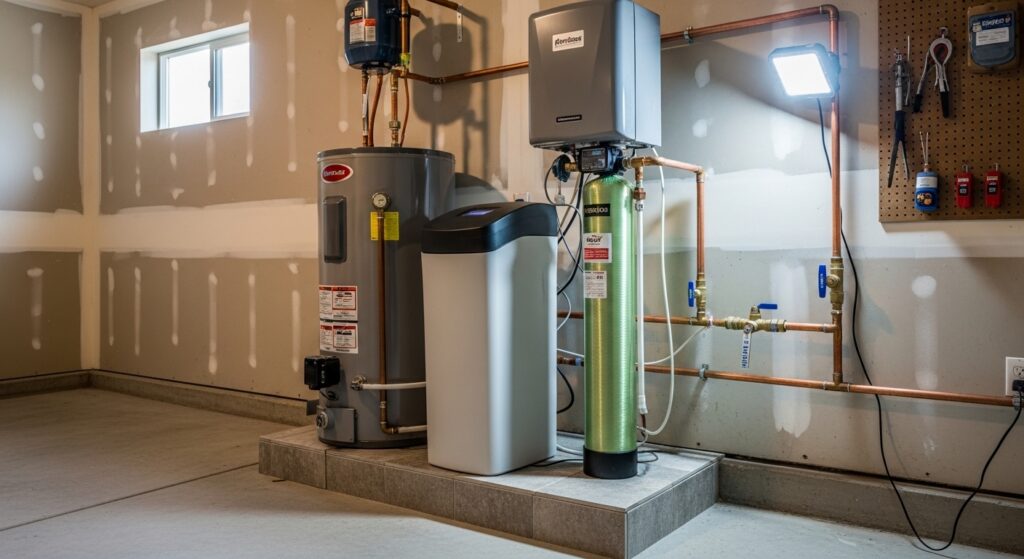
A salt-based system has two tanks. The resin tank holds tiny resin beads coated in sodium. As hard water passes through, the beads grab the calcium and magnesium ions and swap them for sodium ions. That’s the ion exchange.
The brine tank holds the salt. Every few days the system runs a regeneration cycle that rinses the resin clean using salt water, usually around 6 to 8 pounds of salt per cycle. This is the only method that meets the technical definition of “softened” water.
Salt-Free Conditioners: What They Can (and Can’t) Do
A salt-free water softener Phoenix homeowners ask about isn’t really a softener. It’s a conditioner, usually using template-assisted crystallization (TAC). It doesn’t remove minerals. It changes their structure so they’re less likely to stick to pipes, fixtures, and water heaters.
Here’s the honest breakdown:
- Pros: No salt bags to haul, no regeneration discharge water, HOA-friendly, drought-friendly, lower maintenance.
- Cons: You won’t get that slick “soft water” feel in the shower. Laundry won’t feel as soft. Soap scum still forms, just less aggressively.
If your main goal is protecting your water heater and reducing scale, a salt-free unit can do the job. If you want softer skin, brighter laundry, and longer-lasting fixtures, it won’t deliver.
Which System Makes More Sense in the Valley Climate?
With our hardness levels running well above the national average, salt-based ion exchange usually wins on performance. Many homeowners in Ahwatukee and Gilbert pair a salt-based softener with a carbon filter for a whole house water filtration phoenix setup that handles both hardness and chlorine taste.
But salt-based isn’t always allowed. Some HOAs restrict regeneration discharge because of drought rules. Older homes near central Tempe sometimes lack a nearby drain for the brine line. In those cases, a salt-free conditioner or a hybrid approach makes more sense.
Reverse osmosis is a separate conversation. RO handles drinking water at one tap, not whole-house hardness. Many homeowners run both: a softener for the house, an RO unit under the kitchen sink. Our team handles all of these as part of our whole-home plumbing services, so we can size the right combination for your home.
Not sure which system fits your home and HOA? Schedule a consultation online and we’ll walk you through your options.
The Real Cost of Hard Water vs. the Cost of a Water Softener

Hard water is not a free problem. You pay for it every month, just in places you don’t see on a bill labeled “hard water.” Once you add up the energy, repairs, and ruined appliances, the math gets interesting fast.
How Hard Water Quietly Raises Your Bills
Scale builds up everywhere hot water touches metal. Inside your water heater, that layer acts like insulation, forcing the burner or element to run longer to heat the same gallon. The Department of Energy estimates scaled-up water heaters lose roughly 20 to 30 percent of their efficiency.
That is just the start. Hard water shortens the life of dishwashers, washing machines, coffee makers, and ice makers. It restricts pipes over time, which feeds into the kind of plumbing repair and leak detection calls our team runs all over the Valley. You also burn through more soap and detergent because hard water kills lather.
Add it up across a year in a typical Valley home and you are easily looking at a few hundred dollars in extra energy, soap, and shortened appliance life. In a heavy-use household, more.
What a Water Softener System Costs in Phoenix
Installed pricing depends on the type of system, the size of your home, and how the water line is set up. Real-world ranges look like this:
- Salt-based whole-house softeners: roughly $1,000 to $3,500 installed for most homes. Larger homes or premium systems run higher.
- Salt-free conditioners: roughly $500 to $2,000 installed.
- Softener bundled with reverse osmosis: can push $5,000 to $7,000 once you add a whole-home RO stage.
Sizing matters more here than almost anywhere else in the country. Local water hardness is extreme, so an undersized unit will regenerate constantly, wasting salt and water and wearing out the resin faster. A properly sized system installed by a Phoenix metro professional should not need to cycle multiple times a day.
How Long Until a Water Softener Pays for Itself?
For most Valley homeowners, a salt-based system pays for itself in about 2 to 4 years. The big drivers are a longer-lasting water heater, fewer appliance replacements, and lower energy use on year-round hot water. Detergent and soap savings add up too.
Honest answer: not every home sees the same payback. A small household with a newer water heater will save less than a family of five running two dishwashers a week. If you want a straight read on whether the numbers work for your house, our team can walk through it with you.
5 Signs Your Phoenix Home Needs a Water Softener Now
How do you know if you actually need one? Stop guessing and look around your house. Your fixtures, your skin, and your laundry will tell you the truth faster than any sales pitch.
Here are the five signs we see most often in Valley homes:
- Chalky white buildup keeps coming back. You scrub the showerhead, wipe the faucets, clean the tile grout, and the crusty white film returns within weeks. That’s calcium and magnesium scale, and no spray bottle will outpace it long-term.
- Your water heater is acting old before its time. If your tank is under 10 years old but heating slower, popping, or flushing out gritty sediment, hard water is the likely culprit. Scale coats the heating element and forces it to work harder.
- Your skin feels tight after every shower. Lotion helps for an hour, then the dryness comes back. Mineral residue strips natural oils and leaves a film that traps soap on your skin.
- Dishes come out spotty or cloudy. Even with rinse aid and a newer dishwasher, glassware looks foggy and silverware shows water spots. That haze is dried minerals, not detergent failure.
- Laundry feels stiff and dingy. Towels lose their fluff. Dark clothes look faded. Cold cycles don’t help because the problem is the water, not the wash setting.
If two or more of these sound like your home, the next step is simple: get your water tested so you know exactly what you’re dealing with. Our licensed plumbers across the Valley can pull a sample, walk you through salt-based and salt-free options, and size a system that actually fits your household.
Schedule a water assessment with our team online. Stop fighting hard water Phoenix homeowners deal with every day, and let’s figure out the right fix for your home.
Frequently Asked Questions
How Long Does a Water Softener Installation Take in Phoenix?
Most water softener installations completed by Penguin Air, Plumbing & Electrical take between two and four hours for a standard whole-home system. The exact time depends on where your main water line enters the home and whether any pipe modifications are needed. Most homeowners have soft water running through their taps the same day the technician arrives.
Do I Need a Permit to Install a Water Softener in Phoenix?
In most cases, a residential water softener installation in Phoenix does not require a building permit, but any work that involves modifying existing plumbing lines may trigger permit requirements depending on the scope. A licensed plumber from Penguin Air, Plumbing & Electrical can confirm what applies to your specific situation before work begins. Hiring a licensed professional ensures the job meets all local code requirements regardless of permit status.
Can a Water Softener Damage My Septic System?
This is a common concern, but research from the Water Quality Association shows that properly sized and efficiently regenerating water softeners do not harm septic systems. The brine discharge produced during regeneration cycles is not present in high enough concentrations to disrupt beneficial bacteria in a functioning septic tank. If your system is older or undersized, Penguin Air, Plumbing & Electrical can help you choose a high-efficiency model that regenerates only on demand, reducing brine output significantly.
How Often Does a Water Softener Need Maintenance in Phoenix?
Salt-based systems typically need salt refilled every four to eight weeks depending on household size and water usage, though Phoenix’s extremely hard water may push that toward the shorter end. Beyond salt top-offs, most systems benefit from an annual inspection to check resin bed condition, brine tank cleanliness, and valve operation. Penguin Air, Plumbing & Electrical offers maintenance visits to keep your system running at peak efficiency year-round.
Will Softened Water Affect the Taste of My Drinking Water?
Some people notice a very slight change in taste after switching to softened water because ion exchange replaces calcium and magnesium minerals with a small amount of sodium. For most households the difference is undetectable, but those who are sensitive to sodium often pair their softener with a reverse osmosis drinking water filter at the kitchen tap. Penguin Air, Plumbing & Electrical can install both systems together so you get soft water throughout the home and great-tasting filtered water for drinking and cooking.
Is Softened Water Safe to Use for Watering Plants and Landscaping?
Softened water is generally not recommended for regular irrigation because the sodium content can gradually build up in soil and interfere with nutrient absorption in plants. Most Phoenix homeowners install a bypass valve on their outdoor hose bibs so that unsoftened water is used for landscaping while all indoor fixtures receive treated water. Penguin Air, Plumbing & Electrical routinely includes this bypass setup as part of a whole-home softener installation.
What Size Water Softener Do I Need for a Phoenix Home?
Sizing depends on two main factors: the number of people in your household and your incoming water hardness, which in Phoenix typically ranges from 12 to 28 grains per gallon. As a general rule, multiply the number of occupants by 75 gallons per day and then multiply that figure by your water hardness level to find the daily grain capacity your system needs to handle.
Penguin Air, Plumbing & Electrical performs a water hardness test and household usage assessment before recommending a specific unit, ensuring you never end up with a system that is underpowered or wastefully oversized.
Reach Out for Immediate Assistance Now!
Ready to book with Penguin Air, Plumbing & Electrical? Contact us today through our contact page to connect with our team directly.