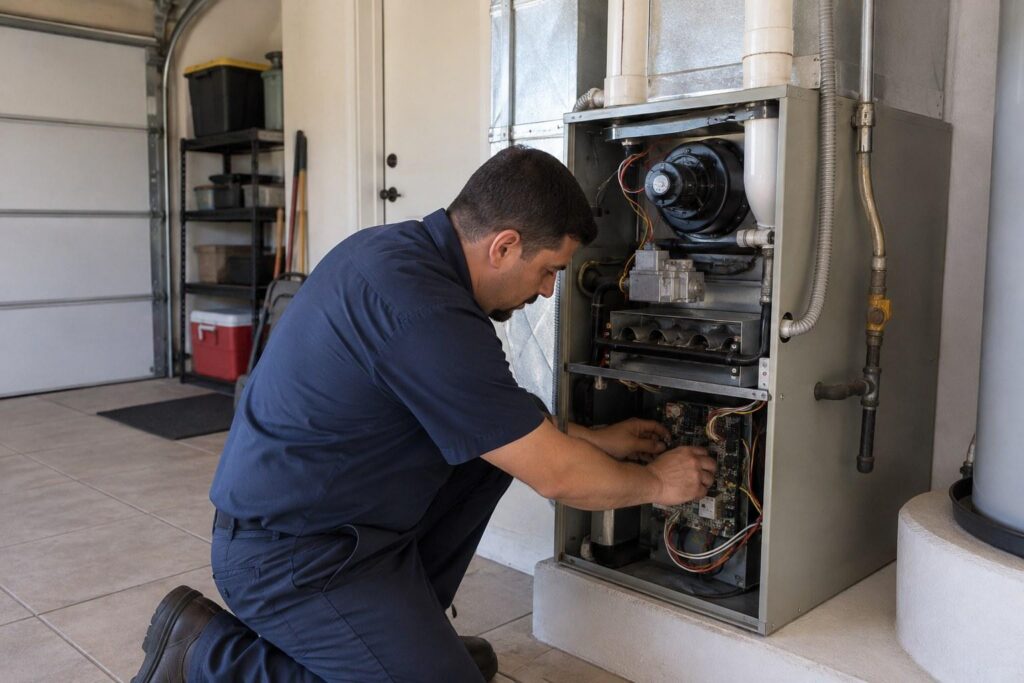
Furnace short cycling happens when your heater fires up, runs for a few minutes, shuts off, and then starts again long before the house feels warm. It is one of the most common heating complaints we hear on chilly desert nights, and it usually points to a specific problem rather than random bad luck. At Penguin Air, Plumbing & Electrical, our technicians diagnose short cycling furnaces across the Valley every winter, from older homes in central Phoenix to newer builds in Gilbert and Surprise. Below, we walk through the seven causes we find most often, what you can safely check yourself, and when it is time to bring in a professional.
If your furnace keeps clicking on and off, a quick diagnostic can save you from bigger repairs later.
Key Takeaways
- Short cycling means the furnace runs in brief bursts of a few minutes instead of completing full, steady heating cycles.
- A clogged air filter is the simplest cause to rule out, and it is one homeowners can fix on their own.
- Oversized furnaces, overheating heat exchangers, dirty flame sensors and blocked vents all trigger the same on and off pattern.
- Many short cycling shutdowns are safety controls doing their job, so repeated resets without a repair are not a real fix.
- High-efficiency furnaces can short cycle when condensate drains or pressure switch tubing get clogged.
- Annual heating maintenance catches most of these problems before the coldest nights of the year arrive.
A healthy gas furnace usually runs long enough to raise the temperature to your thermostat setting, then rests until the house cools again. The exact length varies with outdoor temperature, insulation and system size, but a pattern of very short runs repeating over and over is a sign something is interrupting the cycle.
Phoenix winters are mild by national standards. The National Weather Service lists a normal January low of about 46 degrees at Sky Harbor, and outlying areas like Buckeye, Cave Creek and San Tan Valley often run colder overnight. Because furnaces here sit idle for most of the year, dust, dried out parts and small airflow problems tend to show up all at once when the first cold snap hits.
What Furnace Short Cycling Looks Like and Why It Matters
Common Signs
- The burners light and the blower starts, but everything shuts down within a few minutes.
- The system restarts shortly after, sometimes many times an hour.
- Rooms never quite reach the thermostat setting, or some rooms feel warm while others stay cold.
- Your gas bill from Southwest Gas or your electric bill from APS or SRP creeps up even though the house feels less comfortable.
If your furnace runs but only pushes out cool air, or the pilot or igniter will not light, that is a different set of problems. Our post on why a furnace is not blowing hot air covers those no-heat situations.
Why It Is Worth Fixing Quickly
Every startup works the igniter, inducer, gas valve and blower, so dozens of extra starts a day add wear to each part. Short cycling also wastes fuel, because a furnace is least efficient during its first few minutes of operation.
Comfort suffers too, and in some cases, the shutdowns come from a safety control reacting to overheating or poor venting, which is something you never want to ignore.
Causes 1 and 2: A Dirty Air Filter or an Oversized Furnace

We start with these two because they sit at opposite ends of the spectrum. One is the easiest fix in the house, and the other is built into the system from the day it was installed.
Cause 1: A Clogged Air Filter
Your furnace needs a steady stream of air moving across the heat exchanger to carry heat away. When the filter is packed with dust, that airflow drops, heat builds up inside the cabinet, and the high limit switch shuts the burners down to protect the equipment. Once things cool off, the burners relight, and the cycle repeats.
Monsoon dust, pet hair, and one filter shared by summer cooling and winter heating mean Phoenix filters load up fast. The U.S. Department of Energy (DOE) recommends checking your filter every month during heavy use and replacing it when it is dirty, or at least every three months.
Pull the filter out and hold it up to a light. If you cannot see light through it, replace it. Our guide to choosing the right HVAC filter for your Phoenix home explains how to pick a filter that traps dust without choking airflow. Very restrictive high-rated filters can cause the same overheating problem as a dirty one in some systems.
Cause 2: An Oversized Furnace
Bigger is not better when it comes to heating equipment. The DOE notes that many older furnaces and air conditioners are oversized for the homes they serve. An oversized furnace pumps out so much heat that it satisfies the thermostat in just a few minutes, shuts off, and then starts again as soon as the temperature drifts down.
This is common in the Valley, where heating loads are small and some homes were fitted with equipment sized by rule of thumb rather than a proper load calculation. Upgrades like new windows or added attic insulation can also shrink your heating needs, leaving a once-correct furnace oversized.
The clue is a furnace that heats the house quickly and evenly, shuts off cleanly, but runs in very short bursts no matter how cold it gets. There is no filter swap for this one. Options range from adjusting blower and staging settings on some models to choosing a properly sized unit when it is time for furnace installation.
Causes 3 and 4: Thermostat Problems and a Dirty Flame Sensor
Sometimes the furnace itself is fine, and the problem is the signal telling it when to run. Other times, a small safety sensor loses track of the flame.
Cause 3: Thermostat Placement or Failure
Your thermostat only knows the temperature of the air right around it. If it sits near a supply register, in a sunny hallway, above a lamp, or next to the kitchen, it warms up faster than the rest of the house and tells the furnace to quit early. A few minutes later it cools, and the furnace starts again.
Thermostats can also fail. Weak batteries, loose wiring, or a worn out sensor can produce erratic calls for heat. Some thermostats also have cycle rate or “swing” settings that, if set too tight, call for heat too often. Our post on the signs of a bad thermostat covers the symptoms to watch for.
Here is what you can safely try:
- Replace the thermostat batteries if it uses them.
- Make sure no lamps, electronics or direct sunlight are heating the thermostat.
- Check that a supply vent is not blowing warm air straight at it.
- Review the installer settings in the manual, or ask a technician to confirm them.
If the thermostat is in a poor spot, relocating it or switching to a smart model with remote sensors can solve short cycling without touching the furnace.
Cause 4: A Dirty or Failing Flame Sensor
Gas furnaces use a flame sensor, a thin metal rod that sits in the burner flame, to confirm that gas is actually burning. If the sensor cannot detect the flame, the control board shuts off the gas within seconds as a safety measure. That is a good thing, because it keeps raw gas from flowing into the burner area.
Over time the rod picks up a thin coating that weakens its signal. The result is a very distinctive pattern: the burners light, run for a few seconds, then shut off, and the furnace tries again. After several failed tries, many furnaces lock out completely.
Because the flame sensor sits inside the burner compartment next to the gas valve and burners, we recommend leaving it to a trained technician. Cleaning or replacing it is quick during a service visit, and a technician will also check grounding, wiring and gas pressure, which can cause the same symptom.
Not sure which of these is behind your furnace’s on and off behavior? Our team can test the controls and track down the cause.
Cause 5: Overheating and the High Limit Switch
The high limit switch is one of the most important safety controls in your furnace. It monitors the temperature inside the cabinet and shuts the burners off if things get too hot. When something keeps causing overheating, the limit switch trips again and again, and you get short cycling.
What Makes a Furnace Overheat
Overheating almost always comes back to airflow. Beyond a dirty filter, common culprits include:
- Closed or blocked supply registers and return grilles, often covered by furniture or rugs.
- Crushed, disconnected or leaking ductwork in the attic.
- A dirty blower wheel or a weak blower motor.
- Dirty evaporator coil sitting on top of the furnace, which restricts air on the way through.
Walk through the house and make sure every vent is open and clear. Closing vents in unused rooms might seem like a way to save energy, but it raises pressure in the ducts and can push a furnace into overheating. If the airflow problem is in the ducts themselves, air duct repair may be what fixes the cycling.
A Faulty Limit Switch
Sometimes the switch itself is the problem. A worn limit switch can trip at a lower temperature than it should, shutting down a furnace that is not actually overheating. A technician can measure temperature rise across the furnace and test the switch to tell the difference.
Why Repeated Overheating Needs Attention
Running hot over and over stresses the heat exchanger, the metal chamber that separates combustion gases from the air you breathe. A cracked heat exchanger can let combustion gases, including carbon monoxide, into the airflow. Make sure you have working carbon monoxide alarms. If a CO alarm sounds, get everyone outside to fresh air right away and call 911.
Cause 6: Blocked Flue, Vents or Pressure Switch Problems
Gas furnaces have to safely vent combustion gases outside. Modern furnaces use an inducer motor to draw those gases through the flue, and a pressure switch confirms the draft is working before the burners can stay lit. If the venting is restricted, the pressure switch opens and the furnace shuts down.
What Blocks a Flue or Vent
In Phoenix, we find birds’ nests, wind-blown debris after monsoon storms, roofing work that knocked a vent cap loose, and occasionally a vent pipe that has separated in the attic. Rooftop package units, common in many Valley neighborhoods, can also collect dust and debris around the vent hood.
On high-efficiency furnaces, check that nothing is stacked against the plastic intake and exhaust pipes on the side wall or roof.
Signs of a Venting Problem
- The inducer motor runs, but the burners do not light or shut off quickly.
- You hear unusual rattling or humming from the inducer.
Venting problems are a safety issue, not a nuisance. Do not try to bypass or adjust the pressure switch. If you ever smell gas near the furnace, leave the home immediately without flipping switches or using flames, then call Southwest Gas’s emergency line or 911 from a safe distance. Our post on the signs of a gas leak explains what to watch for.
| What you notice | Likely cause | Safe first step |
|---|---|---|
| Runs a few minutes, cabinet feels hot, filter looks gray | Dirty filter causing overheating | Replace the filter |
| Heats quickly and evenly but runs very short cycles | Oversized furnace | Schedule a load and sizing evaluation |
| Shuts off early, thermostat near a vent or sunny spot | Thermostat placement or settings | Check location, batteries and settings |
| Burners light, then go out within seconds | Dirty or failing flame sensor | Call a technician |
| Burners shut off after several minutes, airflow feels weak | Overheating and high limit switch | Open all vents, check filter, then call |
| Inducer runs but burners will not stay lit | Blocked flue or pressure switch issue | Check outside vents from the ground, then call |
| High-efficiency unit, water near furnace or gurgling | Clogged condensate drain or trap | Call a technician |
Cause 7: Condensate Problems on High-Efficiency Furnaces

High-efficiency furnaces pull so much heat out of combustion gases that water vapor condenses inside the unit. That water drains out through a trap, tubing and a drain line, sometimes with help from a small pump. When any part of that system clogs, water can back up and trip a safety switch, or block the pressure switch tubing, and the furnace shuts down.
Why Phoenix Homes See This
Dust, debris and algae are a tough combination for small drain lines. Your furnace drain may also share a line with the air conditioner’s condensate, which runs hard all summer and can collect algae and sludge long before heating season.
Signs to Look For
- Water pooling around the base of the furnace or in a drain pan.
- Gurgling sounds from the furnace when it starts.
- A furnace that starts, runs briefly, and shuts down with a pressure switch or drain error code.
You can check that the drain line outlet outside is not blocked by debris, but clearing the internal trap and pressure switch tubing is best left to a technician, who can also confirm that the venting slopes correctly so water drains instead of collecting.
When to Stop Troubleshooting
Once you have replaced the filter, opened every vent, checked thermostat settings and cleared anything sitting against outdoor vents, it is time to stop. Repeatedly resetting the furnace or switching it off and on rarely fixes the underlying problem, and the safety controls that cause short cycling are there for a reason. Our furnace repair technicians test the flame sensor, limit switch, pressure switch, venting and airflow and explain what they find before any work begins. We provide upfront, flat-rate pricing, so you know where you stand.
Ready to get steady, even heat again? Book a visit and we will find out why your furnace keeps shutting off.
Frequently Asked Questions
How long should a furnace run per cycle?
There is no single correct number, because run time depends on the outdoor temperature, insulation, system size and your thermostat settings. In general, a furnace should run long enough to bring the house up to temperature and then rest. If you notice very short runs of just a few minutes repeating many times an hour, especially on cold nights, that pattern deserves a closer look.
Is furnace short cycling dangerous?
Short cycling itself is usually more of a wear and efficiency problem, but some causes are safety related. Repeated overheating can stress the heat exchanger, and venting problems affect how combustion gases leave the home. Keep working carbon monoxide alarms installed, and if one sounds, get everyone outside to fresh air and call 911. Then have the furnace inspected before using it again.
Can a dirty filter really make my furnace turn off?
Yes. A clogged filter restricts airflow across the heat exchanger, so heat builds up inside the furnace cabinet. The high limit switch senses the rising temperature and shuts the burners off to protect the equipment. When it cools, the furnace restarts and the pattern repeats. Replacing the filter is the first thing we recommend checking because it is simple and inexpensive.
Can I clean the flame sensor myself?
We recommend leaving flame sensor service to a trained technician. The sensor sits in the burner compartment near the gas valve and burners, and handling those components incorrectly can create safety risks or damage the control system. A technician can clean or replace the sensor and also check wiring, grounding and gas pressure, which can cause the same quick shutdown symptom.
Will a new thermostat fix short cycling?
It might, if the thermostat is the actual cause. A failing thermostat, loose wiring, incorrect cycle settings or a poor location near a vent or sunny window can all cause the furnace to shut off early. If the problem is airflow, overheating, venting or an oversized furnace, though, a new thermostat will not solve it. A quick diagnosis tells you which is which.
How can I prevent my furnace from short cycling?
Change or check your air filter monthly during heavy use, keep supply registers and return grilles open and unblocked, and keep outdoor vent pipes clear of debris. Most importantly, schedule a heating tune-up before winter. During maintenance, a technician cleans the flame sensor, tests safety controls, checks the condensate drain on high-efficiency units, and verifies proper airflow through the system.
Keep Your Phoenix Furnace Running in Full, Steady Cycles
Short cycling is your heating system’s way of telling you something is interrupting its normal cycle, whether that is a dusty filter, a poorly placed thermostat, an oversized unit or a safety control reacting to a real problem. Start with the simple checks, then let a professional handle the rest. If you live in Phoenix, Mesa, Chandler, Scottsdale, Glendale or anywhere else in the Valley, contact Penguin Air, Plumbing & Electrical to have your furnace diagnosed, and ask about our Penguin Plan maintenance program to keep it running smoothly every winter.
Ready to Get Started with Penguin Air, Plumbing & Electrical?
Penguin Air, Plumbing & Electrical has served Greater Phoenix since 2011 as a locally owned one stop shop for heating, cooling, plumbing, drain and electrical work. Every job is backed by our Job Done Right guarantee and a strong commitment to your satisfaction, with flexible financing options available. Penguin Air, Plumbing & Electrical is located at 3710 E University Dr #1, Phoenix, AZ 85034. Call us at (480) 525-5400.