
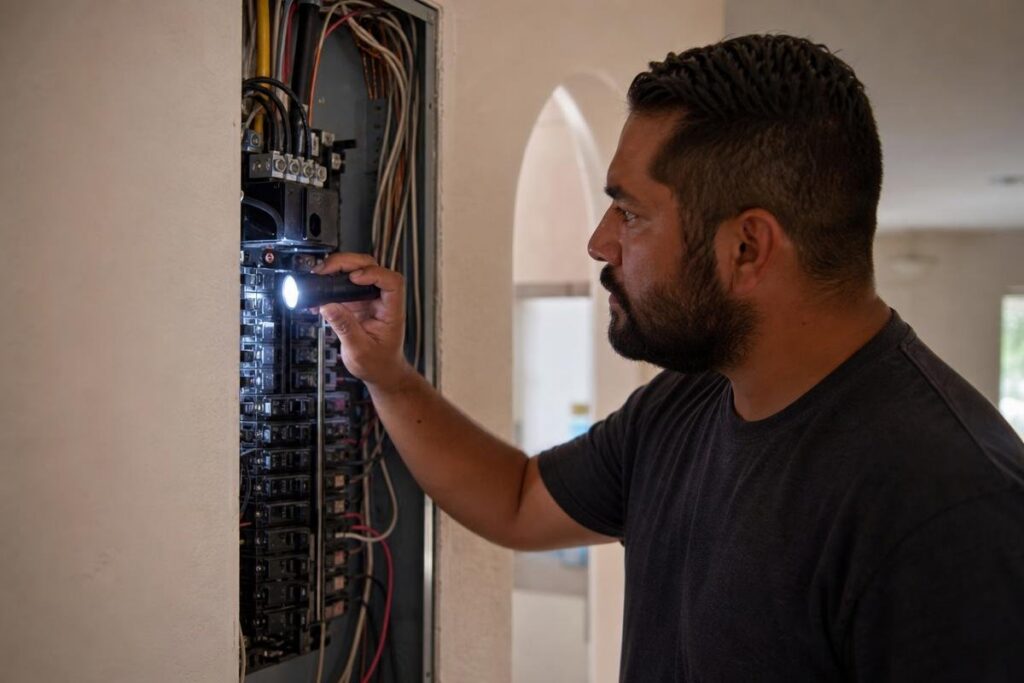
Is your home’s electrical system ready for another Phoenix summer? Here in the Valley, older houses can carry real risks: panels original to 1980s construction, wiring that has taken decades of 150-degree attic heat, and outlets that were never grounded to begin with. Home electrical safety isn’t a once-in-a-while thought. It’s something every Phoenix homeowner should check on a regular schedule. Penguin Air, Plumbing & Electrical (Arizona ROC licensed) has been helping Valley homeowners stay safe since 2011, and this checklist walks you through exactly what to look for.
Think your panel or wiring might be overdue for a look? Our team is ready to help. Call us at (480) 525-5400.
Key Takeaways
- Phoenix homes built before 2000 should have their electrical panels and wiring inspected at least every 10 to 15 years.
- Extreme attic heat accelerates wiring insulation breakdown, making home electrical safety a unique desert-climate concern.
- Aging panels like Zinsco and Federal Pacific models are common in Valley homes and carry documented fire and safety risks.
- GFCI outlets are required near water sources, and Phoenix’s high pool ownership rate makes outdoor electrical protection especially important.
- Monsoon-season voltage spikes from July through September can quietly degrade your wiring over multiple storm seasons if surge protection is not in place.
According to the NFPA’s home structure fires research, electrical failures and malfunctions rank among the leading causes of home fires nationwide, and homes with older wiring or overloaded panels carry the highest risk. Valley homes face a combination of stressors that most generic electrical safety guides completely ignore. A/C systems running nearly nonstop from May through October, monsoon voltage spikes each storm season, and a large housing stock built during the 1970s and 1990s building booms all add up. Most homeowners in the Greater Phoenix area don’t think about any of it until something goes wrong.
This guide gives you a practical home electrical safety checklist built specifically for Chandler, Gilbert, Goodyear, and every other corner of the Phoenix Metro Area. We cover outlets, cords, appliances, breaker panels, and outdoor wiring. These are real electrical safety tips for homeowners who want answers, not guesswork.
Why Phoenix Homes Face Unique Electrical Safety Risks
Most generic electrical safety guides are written for homes in the Midwest or Northeast. They don’t account for what Greater Phoenix homeowners actually deal with: brutal summer cooling loads, violent monsoon storms, and a massive wave of homes built during the Valley’s 1970s through 1990s building boom. Those three factors combine to create home electrical hazards that you won’t find covered in a one-size-fits-all checklist.
Summer Cooling Loads and Circuit Overload
Your A/C system runs nearly nonstop through the long cooling season here in the Valley. That sustained amperage demand puts real stress on panels that were often sized for smaller original cooling equipment. Add a second refrigerator in the garage, an electric dryer, and a pool pump, and you’re asking a lot from a panel that may be 30 or 40 years old.
When multiple high-draw appliances run at once on an undersized panel, you get nuisance breaker trips. That’s your panel telling you something is wrong. Over time, that heat degrades wiring insulation, especially in attic runs that bake in triple-digit air temperatures all summer. If you’ve been thinking about a panel upgrade, check out what Phoenix homeowners pay for a panel upgrade before your next cooling season hits.
Monsoon Season Surge Damage
Arizona’s monsoon season brings rapid voltage spikes and brownouts. One bad storm can degrade wiring insulation and fry electronics. Multiple storm seasons compound that damage quietly, long before you see a visible sign of trouble.
Point-of-use surge strips help, but they’re not enough on their own. Whole-home surge protection installed at your main panel is the right defense against monsoon surges. Stopping surge damage before it builds up is one of the most effective steps you can take to protect an aging system.
Aging Wiring in 1970s-1990s Phoenix Homes
Homes built across the Valley during those boom decades carry specific risks. Aluminum branch-circuit wiring was common in the late 1960s and early 1970s. Federal Pacific Stab-Lok and Zinsco/Sylvania panels showed up heavily in 1980s and 1990s construction. Both panel brands are known defect products. Two-prong ungrounded outlets are standard in both eras.
If your Chandler, Glendale, or Goodyear home was built before 1995 and hasn’t had a full electrical safety inspection, now is the time to schedule one. These aren’t cosmetic issues. They’re active fire and shock hazards hiding behind your walls.
Not sure what your inspection found actually means? Talk to a licensed Phoenix electrician today and get a straight answer.
The Room-by-Room Home Electrical Safety Checklist
Walk through your home with this checklist and check each item room by room. If you find something that doesn’t pass, write it down. Some fixes are simple. Others need a licensed electrician.
What Electrical Safety Checks Should I Do in My Kitchen?
In the kitchen, test every outlet near the sink for GFCI protection, confirm high-draw appliances are on dedicated circuits, and watch for scorch marks or warm outlet covers. The kitchen is one of the highest-risk rooms in any home because you have water, heat, and high-draw appliances all in the same space. Older homes in Chandler, Gilbert, and Goodyear often lack proper GFCI protection near sinks.
- Test every outlet within 6 feet of the sink for GFCI protection. Press the test button. If it doesn’t trip, the outlet needs replacing.
- Make sure your refrigerator is plugged directly into a wall outlet, never into an extension cord.
- Confirm your microwave, dishwasher, and garbage disposal each have dedicated circuits. These appliances draw too much power to share.
- Check that no countertop appliances are plugged into the same outlet simultaneously during heavy use.
- Look for scorch marks, discoloration, or warm outlet covers. These are warning signs of an overloaded circuit.
Are Bathroom and Laundry Outlets Required to Have GFCI Protection?
Yes. Every bathroom outlet in your home must have GFCI protection, no exceptions, and laundry outlets near water sources need it too. Water and electricity are a dangerous combination. This applies to Buckeye and Laveen homes just as much as newer builds in Fountain Hills.
- Test all bathroom outlets for GFCI protection. If you don’t see a test/reset button, the outlet is likely unprotected.
- Never use extension cords in bathrooms or laundry rooms.
- Confirm your dryer runs on a dedicated 240V circuit. Running it on a shared circuit is a fire risk.
- Check that your washing machine outlet is GFCI-protected if it’s within reach of water sources.
- Inspect the dryer vent and cord for heat damage. Lint buildup combined with a frayed cord is a leading cause of home electrical fires.
Living Room, Bedrooms, and Hallways
These rooms see the most extension cord and power strip use. Daisy-chaining power strips is one of the top fire-prevention mistakes we see. Use surge-protected strips for entertainment centers and home office setups instead.
- Replace any two-prong ungrounded outlets with grounded three-prong outlets. Adapters are not a safe fix.
- Check that no power strips are plugged into other power strips.
- Look for ceiling fans or light fixtures that flicker, buzz, or spark. Our team handles ceiling fan and lighting repair in Phoenix if you spot any of these signs.
- Make sure no cords run under rugs or through doorways. Heat builds up and insulation breaks down fast, especially in homes where attic runs already stress wiring.
- Check that bedroom outlets near nightstands aren’t overloaded with phone chargers, lamps, and alarm clocks all on one circuit.
Garage, Outdoor, and Pool Area Wiring
This is where electrical safety tips for homeowners in the Valley get very specific. Monsoon season brings voltage spikes. UV exposure and sustained heat degrade outdoor wiring faster here than almost anywhere else in the country. If you have a pool, this section is not optional.
- Confirm all garage outlets have GFCI protection. This is required by code and commonly missing in older homes.
- Check outdoor outlet covers. They must be weatherproof and rated for wet locations, especially heading into monsoon season.
- Inspect evaporative cooler wiring on your rooftop annually. UV and heat exposure cause insulation to crack and fail.
- Verify your EV charger is on a dedicated 240V circuit. Never run it off a standard outlet or extension cord.
- Pool pump motors and underwater lighting must be on dedicated circuits with GFCI protection per NEC code. This is non-negotiable.
- Check pool bonding connections annually. Loose or corroded bonding is a shock hazard in and around the water.
- Look for exposed or cracked wiring near outdoor outlets, irrigation controls, or landscape lighting runs.
How to Read Your Circuit Breaker Panel Like a Pro
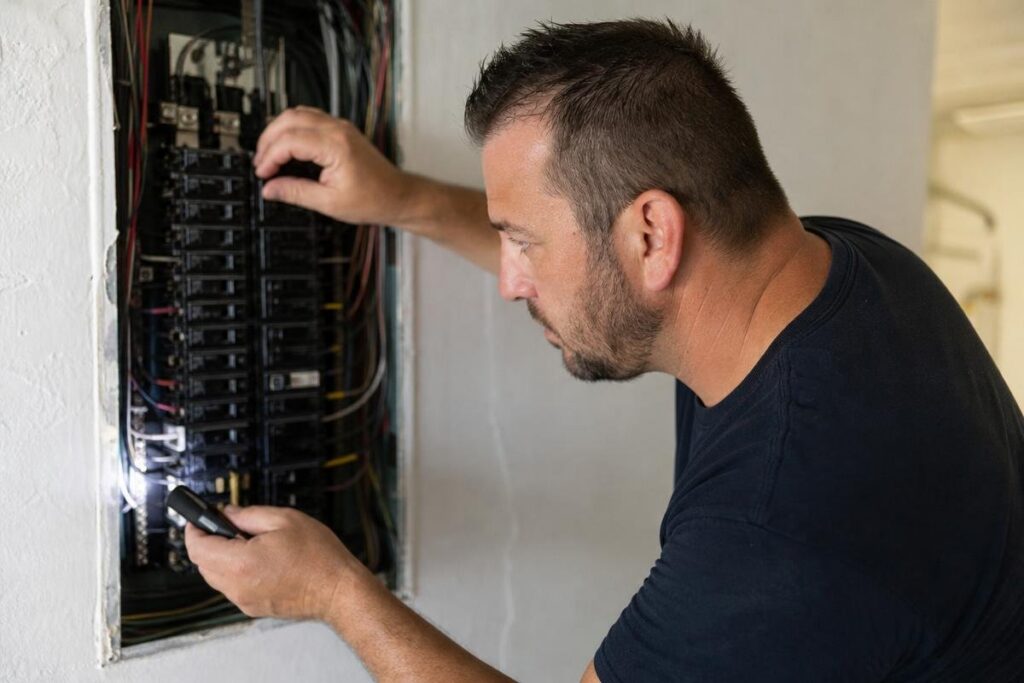
Your circuit breaker panel is the safety headquarters of your home. It is not just a gray metal box in the garage or utility closet. Every breaker in that panel is a built-in protection device, and knowing how to read it can help you spot electrical hazards before they become serious problems.
What a Tripped Breaker Is Actually Telling You
A tripped breaker sits in the middle position, not fully on or fully off. That is the panel doing its job. The question is why it tripped.
There are two different situations here. A nuisance trip usually means you overloaded the circuit, too many appliances running at once. A symptom trip points to something deeper, like a failing appliance, a short circuit, or a wiring fault. That second type needs more than a simple reset.
Here is how to reset a tripped breaker correctly:
- Push the breaker firmly all the way to the OFF position first.
- Then flip it fully to ON.
- If it trips again immediately, stop. Do not reset it a third time. Call a licensed electrician.
Repeated trips on the same circuit are a red flag for circuit breaker safety. That circuit is telling you something is wrong.
Warning Signs Your Panel Needs Professional Attention
Do a quick visual and sensory check on your panel every few months. Watch for these six warning signs:
- The same breaker trips repeatedly
- Burning smell or scorch marks near any breaker
- Buzzing or crackling sounds from inside the panel
- Breakers that feel warm or hot to the touch
- Lights flickering when the AC or another large appliance kicks on
- Double-tapped breakers, two wires under one terminal, which is a code violation and a fire risk
If your Chandler or Goodyear home was built before 1990, check the panel brand. Federal Pacific Stab-Lok and Zinsco/Sylvania panels are common in Valley homes from that era. Most licensed electricians and insurance carriers recommend replacing them. Phoenix’s relentless summer heat cycles worsen loose connections inside these older panels over time. You can find more detail on electrical panel upgrade costs in Phoenix if you suspect yours needs replacing.
If you spot any of these warning signs, skip the DIY fix. Our team handles general electrical repair in Phoenix and can assess your panel safely.
Appliance and Cord Safety: The Rules Most Homeowners Skip
These are the electrical hazards that cause the most fires and get the least attention. Most homeowners assume cords and appliances are low-risk. Our team has seen the aftermath. They are not.
Extension Cord Dos and Don’ts
Extension cords are temporary tools. They are not permanent wiring. That distinction matters a lot for preventing fires.
- Match the cord’s amperage rating to the appliance. Most household cords handle 10 to 15 amps. Plug in something that draws more, and the cord overheats.
- Never run a cord under a rug, through a doorway, or behind furniture. Heat has to go somewhere. If it can’t escape, you have a fire risk.
- Check for cracked insulation, bent prongs, or a plug that feels warm. Any of those signs means replace it now, not tape it up.
- Inspect seasonal cords before you plug them in. Attics in Chandler, Gilbert, and Goodyear routinely hit 150 degrees in summer. A cord that sat up there all season may look fine and still be dangerously degraded. Read our holiday and seasonal lighting safety tips before you string anything up.
Appliance Safety Habits That Prevent Fires
Small habits make a real difference. Follow these every day:
- Unplug small appliances when you are not using them. Toasters, coffee makers, and hair dryers draw standby power and can arc if the cord is even slightly damaged.
- Never run the dryer unattended. Lint plus heat is a proven fire combination.
- Replace any appliance with a frayed cord. Do not tape it. Tape is not a fix.
- Keep 3 feet of clearance around your electrical panel at all times.
- Make sure smoke detectors are within 10 feet of each bedroom and on every floor. Electrical fires often start at night.
Can you tape a frayed cord? No. The insulation is compromised and heat will find the gap. Replace the cord or the appliance.
Spotted a wiring concern or want a professional set of eyes on your system? Call our team at (480) 525-5400 and we will get it handled.
When to Call a Licensed Electrician Instead of DIYing It
Here is the simple rule: if the work touches wiring, a breaker, or anything inside your electrical panel, stop and call a pro. Some tasks are perfectly safe to handle yourself. Others carry real legal and safety consequences if you get them wrong.
In Arizona, unpermitted electrical work can void your homeowner’s insurance and create serious problems when you sell. Homes in the Greater Phoenix area that changed hands during the 1980s and 1990s building booms often have unpermitted work from prior owners already baked in. A licensed electrician can spot it. You might not.
Jobs That Are Never DIY Territory
Arizona law requires a licensed electrical contractor for most work beyond basic fixture swaps. Here is what falls in that category:
- Adding or moving outlets
- Installing a new circuit or subpanel
- Upgrading your main electrical panel
- Installing an EV charger
- Any work inside the main panel itself
- Replacing aluminum branch-circuit wiring with copper
Safe DIY tasks are a short list: replacing a light switch cover plate, swapping a light fixture on an existing circuit, or resetting a tripped breaker. That is about where it ends.
Pool and spa wiring is another hard stop. Given how many homes in the Chandler, Gilbert, and Goodyear areas have backyard pools, bonding and GFCI protection around water is not a task to guess at. The code requirements are specific and the risks are serious.
If you are unsure where to start, reading up on how to choose a licensed electrician in Phoenix can help you ask the right questions before hiring anyone.
What a Professional Electrical Safety Inspection Covers
A professional electrical safety inspection in Phoenix goes well beyond a visual walkthrough. Here is what our team checks:
- Testing every GFCI and AFCI outlet in the home
- Inspecting the panel for overloaded circuits and double-tapped breakers
- Checking for aluminum branch-circuit wiring
- Inspecting outdoor and pool wiring for current code compliance
- Verifying smoke and CO detector placement
- Identifying unpermitted work from prior owners
If your home has never had a professional electrical inspection, scheduling one now is a practical step. It is not an overreaction. It is just good home ownership.
Phoenix-Specific Electrical Safety Tips You Won’t Find in Generic Guides
Generic electrical safety guides are written for everyone, which means they’re written for no one in the Valley. The Greater Phoenix area has three specific conditions that demand their own electrical safety tips for homeowners: monsoon storms, extreme attic heat, and one of the highest pool ownership rates in the country.
Protecting Your Home During Monsoon Season
Monsoon storms roll through the Valley from summer into early fall, bringing rapid voltage spikes and brownouts that hit your wiring and appliances hard. A single surge strip on your TV does almost nothing. The right answer is a whole-home surge protector installed at your main panel. It guards every circuit in the house, not just the outlets where you happen to plug in a strip.
After a major storm, check your breaker panel for tripped breakers and test your GFCI outlets. A full electrical safety inspection is worth scheduling if a storm knocked out power or you noticed anything unusual afterward.
High-Heat Wiring Stress and Attic Runs
Attic temperatures in the Valley can push past 150 degrees in summer. Wiring insulation is rated for specific temperature ranges, and years of extreme heat cycling cause it to become brittle and crack. That cracked insulation is a serious fire-prevention issue, not just a code concern.
If your home was built before 2000, the wiring routed through your attic deserves a close look. Our team recommends an electrical safety inspection for any older Chandler, Gilbert, or Goodyear home that hasn’t had its attic wiring checked in the last decade.
Pool and Spa Electrical Safety in the Valley
Greater Phoenix has one of the highest residential pool ownership rates in the country. Pool electrical systems require bonding, grounding, GFCI protection on pump circuits, and code-compliant underwater lighting. Voltage near water is immediately life-threatening.
- Schedule a licensed electrician to inspect your pool’s electrical system every year.
- Always inspect after monsoon season. Surge damage can affect pump controls without tripping a breaker.
- Never assume the system is safe because it worked last summer.
Annual pool electrical inspections are the correct standard here, not a suggestion.
Frequently Asked Questions
How often should a Phoenix home get an electrical inspection?
For homes under 25 years old, plan on an inspection every 3 to 5 years. Older homes need one every 1 to 2 years. You should also schedule an electrical safety inspection with Penguin Air, Plumbing & Electrical after buying a home, after a major renovation, or after a serious monsoon storm. Voltage spikes and brownouts from monsoon season stress wiring over multiple years, and that damage is not always visible from the outside.
What is a GFCI outlet and do I need one?
A Ground Fault Circuit Interrupter detects a ground fault and shuts off power in milliseconds. That speed is what prevents electrocution. Code requires GFCI outlets in kitchens, bathrooms, garages, outdoor areas, and near pools or spas. Homes built before the mid-1970s in the Chandler and Gilbert areas often lack them in every required location. If your home is that age, have an electrician check every zone.
How do I know if my home has aluminum wiring?
Homes built roughly between 1965 and 1973 are the most likely candidates. That window lines up with a major growth era across the Valley. Warning signs include warm outlets, flickering lights, and a faint burning smell near receptacles. Only a licensed electrician can confirm it by opening an outlet safely. Aluminum wiring is silver-colored; copper is orange-gold. Do not open outlets yourself to check.
Why are my lights flickering?
Brief flickering when a large appliance kicks on can be normal. Persistent flickering, flickering across multiple circuits, or flickering paired with a buzzing sound or burning smell is not normal. Those are signs of a loose connection, an overloaded circuit, or a failing breaker. The heat cycling that Goodyear and Buckeye homes go through every summer worsens loose connections over time. That kind of flickering warrants a call to an electrician, not a wait-and-see approach.
Does whole-home surge protection actually work?
Yes. A whole-home surge protector clamps voltage spikes before they reach your circuits and appliances. It will not protect against a direct lightning strike, but it handles the rolling surges and brownouts that hit during monsoon season. Point-of-use power strips only protect the devices plugged into them. Whole-home protection covers every circuit in the house, including your HVAC system.
What should I do if I smell burning near my electrical panel?
Turn off the affected circuit at the breaker immediately. If the smell is coming from the panel itself, do not touch it. Leave the home and call an electrician. If you see smoke or flames, call 911 first. A burning electrical smell is never a wait-and-see situation. Once the immediate danger is handled, you will need emergency electrical repair in Phoenix before using that circuit again.
If you worked through this checklist and found something that concerns you, or if your home has never had a professional electrical inspection, our licensed electricians are ready to help. Call Penguin Air, Plumbing & Electrical at (480) 525-5400 or book online. We are based right here in the Valley at 3710 East University Dr Suite 1, Phoenix, AZ 85034, and we know exactly what these homes need.
Ready to Get Started with Penguin Air, Plumbing & Electrical?
Call (480) 525-5400 to speak with our team directly. We’re ready to answer your questions, walk you through your options, and help you find the right solution for your needs. Whether you’re just starting to plan or ready to move forward, we’ll make the process simple and stress-free.
Reach out today and let’s talk about how we can help.