
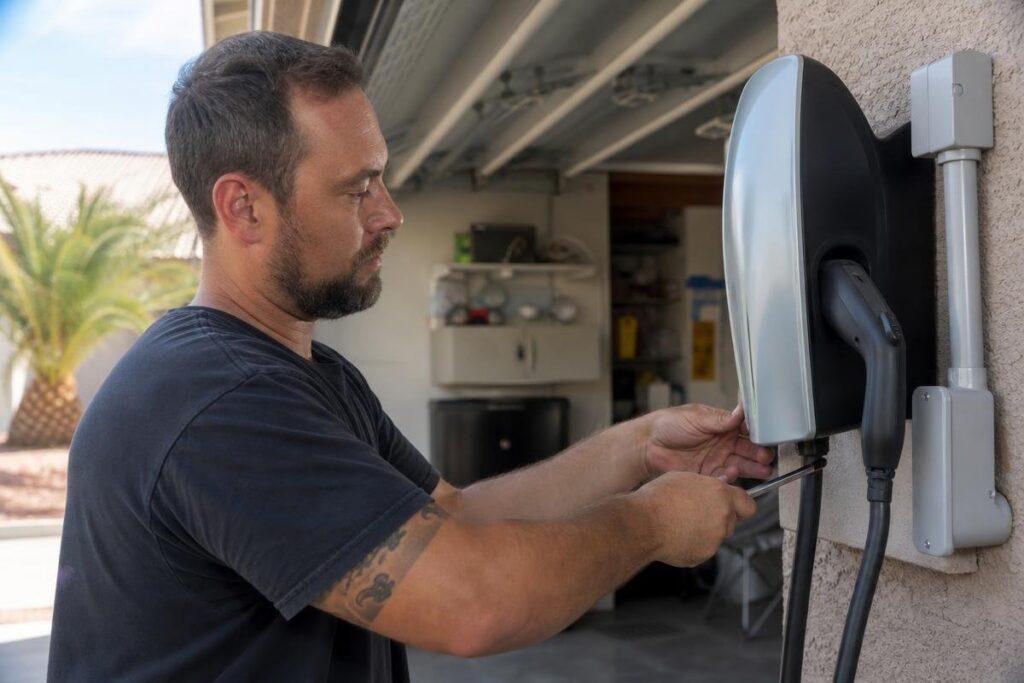
You just got an EV and now you’re wondering whether to plug into a standard outlet or install a level 2 home charging station. It’s a common question here in Phoenix, and the answer affects how fast your car charges, what you pay on your APS or SRP bill, and whether your electrical panel can even handle the upgrade safely. Our team at Penguin Air, Plumbing & Electrical has been helping Valley homeowners with electrical upgrades since 2011. We are a licensed Arizona electrical contractor (ROC 289252) and hold a BBB A+ Rating you can verify before you ever call us.
Ready to add a faster home charger? Our licensed electricians will confirm your panel can handle it first.
Key Takeaways
- A level 2 home charging station charges most EVs 5 to 8 times faster than a standard 120V outlet.
- Many older Phoenix homes need a panel upgrade before a Level 2 charger circuit can be safely installed.
- Scheduling overnight charging on SRP or APS time-of-use plans can meaningfully cut your monthly electricity bill.
- Outdoor carport installs require a weatherproof, NEMA-rated charger enclosure, especially during monsoon season.
- A licensed electrician should pull the permit and inspect your panel before any Level 2 charger goes in.
Level 1 vs. Level 2 Home Charging: The Real Difference for Phoenix Drivers
Level 1: The Standard Outlet Option
Level 1 charging uses a standard 120V household outlet, the same kind you plug a lamp into. No special wiring, no electrician needed. You just plug in the cord that came with your car.
The catch is speed. You get roughly 3 to 5 miles of range added per hour. If your EV has a 75 kWh battery and you run it down near empty, expect 40 to 60 hours to fully recharge. That is two full days of sitting plugged in. For most full battery electric vehicles, that simply does not work as a daily charging plan.
Level 1 makes sense for plug-in hybrids with smaller 8 to 16 kWh batteries. Those charge overnight without a problem. But if you drive a full EV, you will almost certainly outpace what a standard outlet can recover each night.
Level 2: The 240V Upgrade
A 240V home EV charger runs on the same voltage as your electric dryer or oven. It requires a dedicated circuit and either a NEMA 14-50 outlet (plug-in style) or a hardwired connection. Hardwired units support higher amperage, typically 48A, and are the more permanent option. Both deliver a dramatically faster charge.
At 32 amps, the charger adds roughly 25 miles of range per hour. At 48 amps, that climbs to 54 miles per hour. Most mid-range EVs charge fully overnight in 8 to 10 hours, and even a larger 100 kWh truck pack comes back to full while you sleep. That is the kind of home EV charging setup Arizona drivers with long daily commutes actually need.
Connector types matter too. Most non-Tesla EVs use a J1772 connector. Tesla uses NACS, but ships with a J1772 adapter, so a standard Level 2 charger works with either.
Why Phoenix Commutes Make Level 1 Impractical
Drivers crossing the Valley daily, think Ahwatukee to Scottsdale or Tempe to Goodyear, routinely put 40 to 60 miles on the car each day. A standard outlet cannot recover that overnight. You wake up with less charge than you need.
Summer heat adds another layer. When temperatures push past 110°F, your car’s battery management system runs longer during charging to regulate temperature. A faster hardwired Level 2 charger shortens the total charging window, which means less time your battery is working hard in peak heat. That is easier on the battery long-term.
If your home has an older panel, you may need an upgrade before adding a 240V circuit. Our guide to electrical panel upgrades for Phoenix homes is a good starting point to check your home’s current capacity.
What Does a Level 2 Home Charging Station Installation Actually Involve?
A Level 2 home charging station installation involves four steps: assessing your electrical panel, running a dedicated 240V circuit, mounting and connecting the charger, and pulling a permit for inspection. Most homeowners picture a simple plug-in job, but each of these stages matters for safety and speed. Here is exactly what happens when our team installs the unit in the Valley.
Step 1: Panel Assessment
Your electrician starts at your main electrical panel, not your garage. We check your panel’s total amperage and how much capacity is actually available after your existing loads. A 40A or 48A EV charger draws real power, and here in the Valley, your panel is already competing with central AC, a pool pump, and possibly an electric water heater.
Homes in Laveen and older central Phoenix neighborhoods often have 100A or 125A panels. That may not leave enough headroom. If yours is one of them, you may need to look into a panel upgrade before the charger circuit can be safely added. Our electricians have completed EV charger installs across the East Valley, West Valley, and central Phoenix, so they know which neighborhoods tend to have tighter capacity.
Step 2: Running the Dedicated 240V Circuit
Your charger gets its own dedicated circuit, not a shared one. For a 40A charger, that typically means 6-gauge copper wire on a 50A breaker. In older homes, your electrician may route conduit through attic space or along exterior stucco walls to reach the garage or carport.
Carport installs require weatherproof conduit rated for outdoor exposure. That is a routine job for our team, but it does add time compared to a straightforward garage run.
Step 3: Mounting and Connecting the Charger
The unit mounts on your garage wall or an exterior wall for carport setups. Most chargers come with a 20 to 25 foot cable, which covers most parking configurations. You can go with a NEMA 14-50 outlet for a plug-in charger or a hardwired connection for a permanent install. Hardwired supports higher amperage and looks cleaner on the wall.
Step 4: Permit and Inspection
Yes, you need a permit. The City of Phoenix requires an electrical permit for any new 240V circuit. Our team pulls the permit through Phoenix Development Services before we start work. The process adds a few business days but protects your homeowner’s insurance coverage and prevents headaches during a future title search if you sell your home. Unpermitted electrical work is a real problem in Arizona, and it is one you do not want to inherit or leave behind.
How Much Does a Level 2 Home Charging Station Cost in Phoenix?
EV charger installation costs in Phoenix vary based on your panel, your home’s layout, and the charger you choose. Here is what drives each piece of the cost.
Charger Unit Cost
Charger unit cost depends on amperage and features. A 32-amp unit works fine for most drivers. A 48-amp unit adds speed and future-proofs the install for higher-capacity vehicles down the road. Smart features like Wi-Fi scheduling, load management, and app control increase cost but pay off if you use SRP’s EV Price Plan or APS’s Saver Choice off-peak rates to charge overnight at lower cost.
Installation Labor and Materials
Licensed electrician labor varies depending on the complexity of the install. Longer wire runs, carport installs, or two-story homes where the panel is far from the parking area push costs higher. Materials, including wire, conduit, a new breaker, and any weatherproof enclosures for outdoor installs, add to the total.
Panel Upgrade Costs
If your home has a 100-amp or 125-amp panel, you may need an upgrade before adding a dedicated EV circuit. Older neighborhoods like Maryvale and Sunnyslope see this more often. Newer subdivisions across the Valley usually already have 200-amp service and skip this step entirely. Panel upgrade costs vary depending on size and complexity. Our blog on electrical panel upgrades for Phoenix homes covers what affects that cost in more detail.
Permit Fees and Federal Tax Credit
Permit fees vary by municipality. Always factor this into your planning. On the savings side, the federal Alternative Fuel Vehicle Refueling Property Credit (Form 8911) may cover a portion of your charger equipment and installation costs. Talk to a tax professional about current eligibility before counting on it.
Not sure if your panel can handle a new charger circuit? Get a free assessment before you spend a dollar on equipment.
Is Your Phoenix Home’s Electrical Panel Ready for a Level 2 Charger?
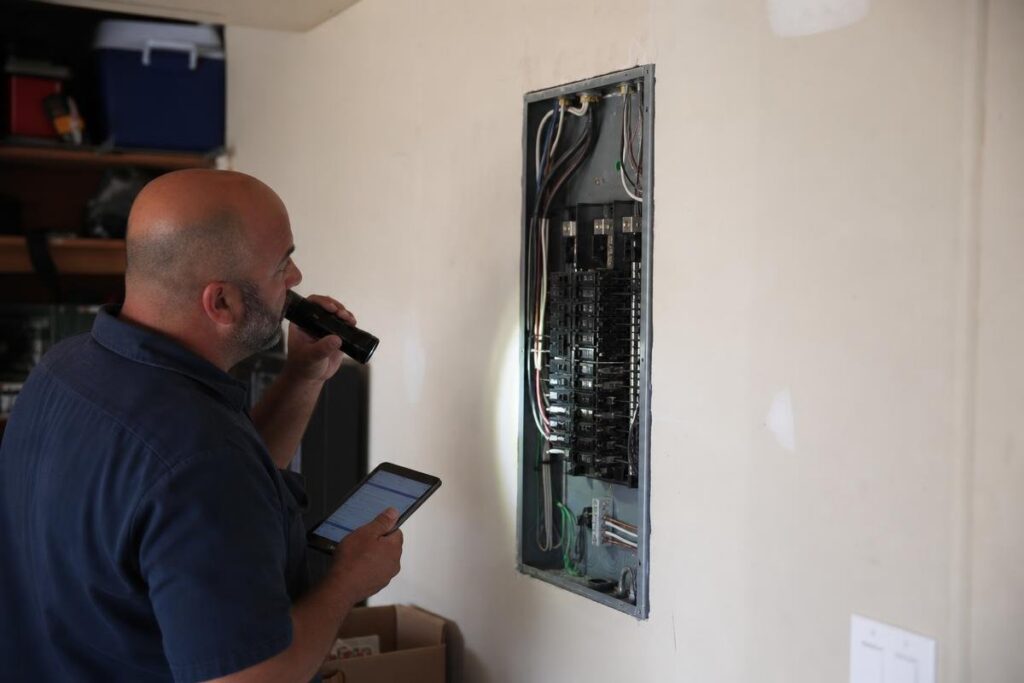
Before any charger goes on your garage or carport wall, your electrical panel has to support it. A dedicated 240V circuit for a home EV charging setup in Arizona typically draws 40 to 50 amps. That is a significant load, and not every panel in the Valley can handle it safely.
Signs Your Panel Is Ready
A 200-amp main panel with open breaker slots is a good starting point. If your panel shows no double-tapped breakers, no visible corrosion or heat discoloration inside the door, and your total connected load leaves 40 to 50 amps of headroom after accounting for your AC, water heater, pool pump, dryer, and oven, you are likely in good shape. Our electricians can confirm that in a quick pre-install assessment.
Signs You May Need an Upgrade
Older homes in Maryvale, Sunnyslope, and South Mountain often have 100-amp or 125-amp panels, which were standard before 1990. Add a 5-ton AC system to that load and the panel is frequently already near capacity. If your breakers trip under normal daily use, or you spot double-tapped breakers, a panel upgrade is likely the right first step before the charger circuit goes in. Read more in our guide to electrical panel upgrades for Phoenix homes before scheduling your install.
Also flag this immediately: Federal Pacific Stab-Lok and Zinsco panels are known safety concerns. We recommend replacing them regardless of any EV charger plans.
What Our Electricians Check Before the Install
Every EV charger installation in Phoenix starts with a panel assessment. Our team checks panel amperage and available capacity, breaker condition, grounding and bonding, and the wire run distance from your panel to the planned charger location. We also confirm the garage or carport wall is suitable for mounting and weatherproofing. If you have not had your panel looked at recently, our guide to 7 signs you need electrical rewiring in your Arizona home is a useful place to start.
Not sure if your panel is ready? Our licensed electricians will assess it before a single wire is pulled. Call us at (480) 525-5400 to schedule a panel check.
Choosing the Right Level 2 Charger for Your Phoenix Home
Not every 240V home charger is the same, and buying the wrong one means spending more than you need to or leaving charging speed on the table. Here is how to match the charger to your car, your home, and your budget.
Amperage: Match the Charger to Your Car
Most EVs on the road today have onboard chargers rated at either 32 amps or 48 amps. That onboard charger is the real ceiling. A 32A onboard charger delivers roughly 25 miles of range per hour. A 48A onboard charger can push 44 to 54 miles per hour. Buying a 48A unit when your car tops out at 32A does not charge your car any faster. Check your vehicle’s spec sheet first.
A 50A circuit supporting a 40A charger is a solid, future-proof choice for most homeowners. A 60A circuit supporting a 48A charger covers virtually every current EV on the market. If you plan to own a higher-capacity EV down the road, sizing up the circuit now is cheaper than rewiring later.
NEMA 14-50 Plug-In vs. Hardwired
A NEMA 14-50 plug-in charger is easier to remove if you sell the home or move. Some units are designed specifically for this format. Hardwired installs connect directly to the circuit, look cleaner on the wall, and support higher amperage without the plug acting as a weak point. For a permanent install in the Valley, hardwired is generally the better call. For carport setups common in Ahwatukee and Laveen, an outdoor-rated enclosure with weatherproof conduit is standard regardless of connection type.
Smart Features That Save Money in Arizona
Wi-Fi scheduling is worth the extra cost here. APS Saver Choice and SRP’s EV Price Plan both offer lower rates during off-peak windows. SRP’s EV Price Plan, for example, offers its lowest rates from 11 p.m. to 5 a.m. Scheduling your setup to run during those hours can meaningfully lower your electric bill in Phoenix this summer and every season after.
Load management features are especially valuable in the Scottsdale and Tempe areas where summer AC runs almost around the clock. This feature tells the charger to pull back when your air conditioner or dryer is running, keeping you from tripping a breaker or overloading your panel during peak demand hours.
Phoenix-Specific Considerations Before You Install a Level 2 Charger
A generic EV charger guide won’t tell you what actually matters here in the Valley. The heat, the monsoons, and your utility provider all shape how your home EV charging setup in Arizona should be planned and installed.
Heat, Monsoons, and Outdoor Charger Ratings
When temps climb past 110°F, your EV’s battery management system throttles charging speed to protect the cells. That means a hot afternoon charge is slower and harder on the battery than an overnight charge. Scheduling your charger to run after 10 p.m. is smarter for battery longevity and easier on your electric bill.
Monsoon season runs July through September and brings lightning, heavy rain, and haboobs. Any outdoor or carport-mounted unit needs at minimum a NEMA 3R enclosure rating. NEMA 4 is better if the charger faces west or sits in a fully exposed spot. We also recommend adding whole-home surge protection before monsoon season hits. If you want a head start on that, our guide to preparing your Phoenix home for monsoon season covers the key steps.
APS and SRP Time-of-Use Rate Plans
Both major Valley utilities reward off-peak charging. APS offers reduced overnight rates through their Saver Choice plan, with the lowest-cost hours falling late at night. SRP’s EV Price Plan cuts costs sharply during its overnight super off-peak window from 11 p.m. to 5 a.m. A smart charger with built-in scheduling can meaningfully lower your monthly bill by shifting charging into those hours. That adds up fast.
Ask your utility which plan you’re currently on before installation. Our team can help you match the right charger to your rate schedule.
Carport Installs in Phoenix Neighborhoods
Many homes in Glendale, Mesa, and older central Valley neighborhoods have carports instead of enclosed garages. That’s a routine install for our electricians, not a problem. It does require weatherproof conduit, an outdoor-rated charger unit, and careful placement to keep the unit out of direct afternoon sun on west-facing walls. Done right, a carport EV charger installation in Phoenix works just as reliably as a garage setup.
Why Phoenix Homeowners Choose Us for EV Charger Installation
Licensed, Local, and Transparent on Price
Our team has been doing EV charger installation in Phoenix since 2011, founded by Arizona natives who know Valley homes inside and out. We are fully licensed, bonded, and insured for electrical work in Arizona under ROC 289252, and we carry a BBB A+ rating with accreditation going back to our first year in business.
You know the full cost before any work begins. Flat-rate pricing means no surprises on the invoice. Our electricians are also familiar with older panel types common in Tempe, Scottsdale, and South Mountain homes, so they spot potential issues before they become problems. You can find us at 3710 E University Dr # 1, Phoenix, AZ 85034, and we serve the full Valley.
Same-Day Availability and 24/7 Service
Need your charger installed fast? We offer same-day availability and 24/7 service. Every technician is background-checked before they set foot in your home. If your panel needs attention before the install can happen, our team handles that too. Read more about when that might apply in our guide to electrical panel upgrades for Phoenix homes.
Frequently Asked Questions
How long does a Level 2 EV charger installation take?
A standard garage install with an accessible panel takes 2 to 4 hours. If your panel needs an upgrade, that is a separate appointment and adds 4 to 8 hours of work. Permitting through the City of Phoenix Development Services adds a few business days to the overall timeline, but it does not delay the physical installation in most cases.
Do I need a permit to install an EV charger in Phoenix?
Yes. The City of Phoenix requires an electrical permit for any new 240V circuit. Our team pulls that permit on your behalf. Skipping it can void your homeowner’s insurance and create real problems when you sell your home.
Will a Level 2 charger work with my vehicle?
The J1772 connector covers virtually every non-Tesla EV on the road. Tesla vehicles ship with a J1772 adapter, so they work too. The Tesla Wall Connector uses NACS natively and is designed for Tesla vehicles.
How much will a Level 2 charger add to my monthly electric bill?
Charging costs vary depending on your battery size and your APS or SRP rate plan. Scheduling charges overnight on an off-peak plan cuts that cost significantly. See our tips on how to lower your electric bill in Phoenix this summer for more ways to manage costs.
Can you install a Level 2 charger on a carport?
Yes, and it is a routine job for our team. The charger must be NEMA 3R or NEMA 4 rated, and all conduit and wiring must be weatherproof. Our electricians assess your specific carport layout before any work begins.
Do you offer flat-rate pricing on EV charger installs?
Yes. You know the full cost before we start. No surprise charges at the end of the job.
Ready to stop guessing about your panel capacity and get a real quote? Call Penguin Air, Plumbing & Electrical at (480) 525-5400 or schedule online. Our licensed electricians pull the permit, run the circuit, mount the charger, and handle the inspection. Same-day appointments are available.
Ready to Get Started with Penguin Air, Plumbing & Electrical?
Call (480) 525-5400 to speak with our team directly. We’re ready to answer your questions, walk you through your options, and help you find the right solution for your needs. Whether you’re just starting to plan or ready to move forward, we’ll make the process simple and stress-free.
Reach out today and let’s talk about how we can help.