
Phoenix air is rough on your lungs. Between olive tree pollen in the spring, haboob season pushing fine dust through every gap in your home, and wildfire smoke drifting into the Valley, the air inside your house can actually be worse than the air outside. Home air purification is one of the smartest investments a Phoenix homeowner can make, and our team at Penguin Air, Plumbing & Electrical has been helping Valley families breathe easier since 2011. We know what your home is up against here, and we know how to fix it.
Ready to stop breathing whatever the desert blows in? Our team can help you find the right air purification setup for your home.
Key Takeaways
- Phoenix haboob season and spring olive tree pollen make indoor air quality a real health concern for Valley homeowners.
- Home air purification works best when it connects directly to your existing HVAC system for whole-home coverage.
- HEPA and activated carbon filters target different pollutants, so the right combination depends on your specific air quality problems.
- Phoenix homes run AC for most of the year, making your HVAC the most cost-effective delivery point for cleaner air.
- Portable purifiers help individual rooms, but a whole-home system is the only way to treat every cubic foot of air you breathe.
What’s Actually in Phoenix’s Air, and Why It Gets Inside Your Home
You close every window, run your AC, and still wake up sneezing. That’s not bad luck. That’s desert air finding its way in through door gaps, window seals, and your HVAC return vents. Here in the Scottsdale and Tempe corridors, just like across the greater metro, homes are under near-constant pressure from dust, pollen, and pollution. Understanding what’s out there is the first step toward actually fixing your indoor air quality in Phoenix.
Dust Storms, Haboobs, and Fine Particulate Matter
Monsoon season runs June through September. During that stretch, haboobs can push walls of fine dust particles (called PM2.5, meaning particles smaller than 2.5 microns) straight through the gaps around your doors, windows, and HVAC return vents. To put that size in perspective, a human hair is about 70 microns wide. PM2.5 particles are invisible, and they pass right through a standard 1-inch HVAC filter like it isn’t even there.
That’s the core problem with basic filters. They’re built to protect equipment, not your lungs. After a haboob rolls through Surprise or Chandler, those particles settle into your ductwork and recirculate every time your system kicks on.
Pollen Season in the Valley: What’s Blooming and When
Pollen exposure here doesn’t follow a simple spring-and-done calendar. Olive trees, one of the most widely planted ornamentals across the metro, peak from February through April and hit allergy sufferers hard. Desert grasses take over from May through July. Then ragweed and mold spores carry the load from August through October, overlapping directly with monsoon humidity spikes that can push moisture into HVAC coils and trigger mold growth.
That’s close to year-round allergen exposure. A portable room purifier handles the air in one room. But pollen travels through your return vents and circulates through the whole house every time your system runs. Room-only filtration doesn’t solve a whole-home problem.
Wildfire Smoke and Urban Pollution
Late spring and early summer bring another layer. Wildfire smoke drifts into the metro from Arizona’s burn corridors, pushing air quality index readings into unhealthy ranges for days at a time. That smoke carries ozone and volatile organic compounds (VOCs), pollutant types that particle filters alone can’t capture. You need activated carbon filtration on top of particle filtration to address those.
Add everyday traffic and industrial activity around the I-10 and I-17 corridors, and the air quality case for a whole-home purification setup becomes hard to ignore. Duct integrity matters here too. If your ductwork has gaps or leaks, smoke and VOCs bypass your filter entirely. Our checklist on AC maintenance for Phoenix homeowners covers duct and filter checks that directly affect how well any purification system performs.
Portable Air Purifier vs. Whole-Home System: Which One Actually Works?
Both options filter air. But they are not the same thing, and the difference matters a lot for homeowners in Scottsdale, Tempe, Surprise, and other parts of the metro dealing with year-round dust, pollen, and wildfire smoke.
What a Portable Air Purifier Can and Can’t Do
A portable HEPA-certified unit does a solid job in one room. Most are rated for 300 to 500 square feet based on their CADR score. That makes them a reasonable pick for renters or for a specific problem room like a bedroom.
The limit is obvious once you think about it. A portable unit only cleans the air where it sits. After a haboob pushes fine dust through every return vent in your home, one unit in the living room does nothing for the bedrooms, hallways, or kitchen. You would need a unit in every room to get full coverage, and the filter costs add up fast at $50 to $150 per unit per year.
How Whole-Home Air Purification Works With Your HVAC
A whole-home system installs directly at your air handler or return air plenum. Every cubic foot of air passes through the purification equipment before it recirculates through your home. That covers every room at once, using the ductwork you already have.
Common whole-home options include high-MERV media filters (MERV 11 to 16), electronic air cleaners, UV germicidal lights at the air handler, and cleaning the air inside your home with an air scrubber continuously. One important note: a technician should assess your existing HVAC before any hardware goes in. The wrong system can restrict airflow or void your equipment warranty.
Duct integrity also matters here. Leaky or poorly sealed ducts pull unfiltered air from attics and wall cavities, which bypasses your purification system entirely and reduces its effectiveness.
The Real Cost Comparison Over Time
Here is a straightforward breakdown:
- Portable units: $100 to $600 upfront per unit, plus $50 to $150 per year in replacement filters, per unit
- Whole-home systems: Higher install cost, but one filter change covers the entire house; UV lights have minimal ongoing consumable costs
Here in the metro, AC systems run 9 to 10 months a year. Your HVAC is already moving air constantly. Adding purification to that existing airflow costs far less than running three or four portable units around the clock. For most homeowners, the whole-home HVAC air purification system pays for itself through filter savings and better coverage within a few years.
If you are not sure which setup fits your home and equipment, our team can walk you through the options based on your actual system.
Understanding Air Purification Technologies: HEPA, UV, Carbon, and More
Not all air purification systems work the same way. Some capture particles. Some kill biologicals. Some neutralize gases. Knowing the difference helps you pick the right setup for your home, whether you’re in Scottsdale, Surprise, or anywhere else across the metro area.
True HEPA and High-MERV Filtration: What the Numbers Mean
A true HEPA filter captures 99.97% of particles 0.3 microns or larger. That includes dust, pollen, pet dander, and mold spores. For a whole-home HVAC air purification system, the equivalent is a MERV 13 to 16 media filter installed at the air handler.
Here’s the catch. Very high-MERV filters restrict airflow more than standard filters do. In older or undersized systems, that extra resistance strains the blower motor and can cause your coil to freeze. Before upgrading to a MERV 16 filter, a static pressure check on your system is a smart first step. Read more about causes and fixes for AC freezing up.
UV Germicidal Lights: Killing What Filters Miss
A HEPA-rated filter catches particles, but it does not kill them. UV-C lights installed at the air handler target mold spores, bacteria, and viruses that slip through or collect on the evaporator coil surface.
This matters here specifically. During monsoon season, outdoor humidity can jump from under 10% to over 50% in just a few hours. That moisture hits your cold evaporator coil and creates a brief but real window for mold growth. A UV germicidal light running continuously at the coil shuts that window down. If you already have a HEPA-style filter, UV adds a second layer that handles what filtration alone cannot.
Activated Carbon and Air Scrubbers for Smoke and VOCs
HEPA filtration does not capture gases or odors. That’s where activated carbon media comes in. It adsorbs VOCs, smoke particles, and chemical off-gassing from new flooring, paint, and cleaning products.
During late spring and early summer, wildfire smoke drifts into the area and pushes air quality index readings into unhealthy ranges. Activated carbon is what stands between that smoke and your lungs. Air scrubber technology takes this further by combining carbon media with photocatalytic oxidation to actively reduce airborne contaminants throughout the home. Our team has covered how this works in more detail in our post on cleaning the air inside your home with an air scrubber.
What to Avoid: Ozone Generators and Their Risks
Ozone generators produce ozone as a byproduct of their operation. Ozone is a lung irritant. The EPA is clear that ozone generators should not be used in occupied spaces, full stop.
If a contractor recommends one for your home, especially if children, elderly family members, or anyone with asthma lives there, treat that as a red flag. There are better, safer options for every air quality problem an ozone generator claims to solve. Ask about activated carbon or UV systems instead.
Not sure which air purification technology fits your home? Our team can walk you through your options and match the right system to your HVAC setup. Call us at (480) 525-5400 to get started.
How to Choose the Right Air Purification Setup for Your Phoenix Home
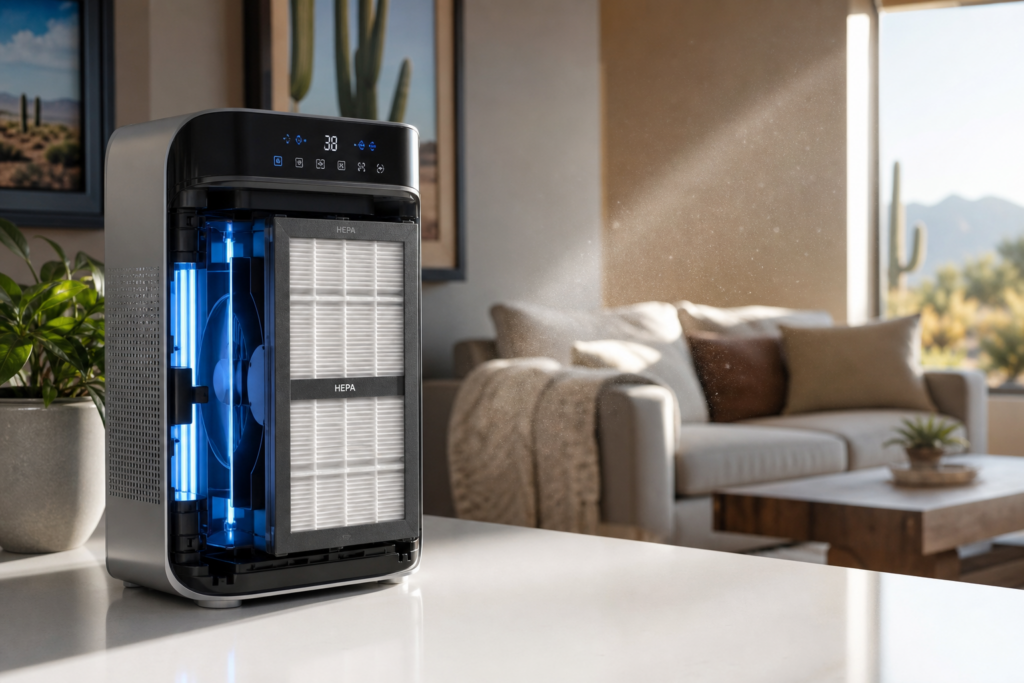
The right setup depends on three things: your home’s square footage, your specific air quality concerns, and the condition of your ductwork. Get those three right and you stop guessing. Here is how to work through each one.
Match the System to Your Home’s Size and Layout
For a single room or apartment, a portable HEPA unit works well. Size it to the room. Look for a CADR rating that is at least two-thirds of the room’s square footage. A 300 square foot bedroom needs a CADR of at least 200.
For homes between 1,500 and 2,500 square feet, a whole home air purifier built around a MERV 13 media filter plus a UV light at the air handler covers most needs. Homes in Scottsdale and Surprise with open floor plans fall right in this range. Homes over 3,000 square feet, or those with multi-zone systems, typically need a whole-home electronic air cleaner or an air scrubber tied into the HVAC.
Here in the greater metro area, AC runs 9 to 10 months a year. That makes your HVAC the most cost-effective distribution point for purification. You are already moving air through the system constantly.
Factor In Your Specific Air Quality Concerns
Use this quick checklist to narrow down what you need:
- Dust and pollen allergies (including spring olive tree season): MERV 13 to 16 filter, changed every 30 to 60 days during haboob season, not the 6-month schedule on the box.
- Mold or biological growth on coils: UV light installed at the air handler coil.
- Wildfire smoke or chemical sensitivities: Activated carbon filter or a whole-home cleaning using air scrubber
- All of the above: A layered system combining MERV 13 to 16 media filtration, UV, and carbon. Given the monsoon humidity swings and late-spring wildfire smoke that reaches Tempe and Chandler, this combination makes sense for a lot of households here.
Don’t Forget Your Air Ducts
Even the best air purifier for dust and pollen underperforms if your ducts are leaking conditioned air into unconditioned attic space or coated in years of accumulated dust. A duct inspection is a smart first step before spending money on hardware. Our post on why AC tune-up matters includes airflow and filter condition checks that can reveal duct problems before you invest in a new system.
Fix the duct issues first. Then layer in the purification. That order saves you money and gets you better results.
Seasonal Air Quality in Phoenix: When to Act and What to Watch For
Indoor air quality in Phoenix does not stay the same year-round. Each season brings a different threat, and if you wait until symptoms hit, you are already behind. Here is what to watch for and what to do before each season peaks.
Monsoon Season (June Through September): Dust and Mold Spike
A haboob can push fine particulate matter through your home’s return vents in minutes. Even well-sealed homes in Scottsdale and Surprise see dust infiltrate during major storms. After a big event, that same moisture that follows the storm wall can spike indoor humidity from under 10% to over 50%, creating a short but real mold-growth window on HVAC coils and inside ductwork.
Change your filter every 30 days during June through September, not on the standard 90-day box schedule. If you have a whole-home purification system, schedule a coil inspection after any significant storm. That one step protects your equipment and the air your family breathes.
Spring (February Through April): Peak Pollen Window
Olive trees are the dominant allergen source across the greater Phoenix area, and they peak hard from February through April. During this window, switch your HVAC fan setting from “auto” to “on.” That keeps air moving through your filter continuously, even when your system is not actively cooling. You catch more pollen on every pass.
Change your filter at the start of February and again in April. Do not wait for the filter to look dirty. Pollen loads up fast and a clogged filter strains your system. Pair that with a review of your full home maintenance checklist so nothing gets missed before the heat arrives.
Winter and Wildfire Season: Smoke and Dry Air
Arizona wildfire smoke can drift into Tempe, Chandler, and surrounding communities any time of year, but late spring and early summer are the riskiest windows. When AQI readings spike into unhealthy ranges, close your windows and run the HVAC fan continuously to keep indoor air filtered. Do not rely on a portable unit alone for a whole home.
Winter also brings extremely dry air, often below 20% relative humidity, which irritates airways and makes dust feel worse. A whole-home humidifier paired with your purification system addresses both problems at once. Before the cold months arrive, review our heating maintenance tips for winters in Phoenix to make sure your system is ready to handle both dry air and smoke events.
Frequently Asked Questions
How often should I change my air filter in Phoenix?
During haboob season, which runs from early summer through September, plan to swap your filter every 30 to 60 days. The rest of the year, every 60 days is usually fine. Homes with pets or allergy sufferers should stay on the shorter end of that range year-round.
Can a whole-home air purifier help with haboob dust?
Yes, but the trick is your fan setting. After a dust storm, switch your thermostat fan from “auto” to “on” so the system keeps circulating air through the filter even when the AC isn’t actively cooling. A MERV 13 or higher filter paired with sealed door and window gaps makes a real difference in how much fine particulate stays in your home.
What’s the difference between an air purifier and an air scrubber?
An air purifier filters particles as air passes through the unit. An air scrubber goes further by using UV light and photocatalytic oxidation to send purifying agents out into the room, reducing contaminants on surfaces and in the air at the same time.
Will a high-MERV filter damage my Phoenix AC system?
It can, if your system isn’t sized for it. MERV 13 to 16 filters are denser, which increases airflow resistance. Older systems or those with smaller blower motors may develop frozen coils or premature motor wear. Our team always runs a static pressure check before recommending a higher-MERV filter. Read more about what that inspection involves in our blog on why AC tune-up matters in Phoenix.
Is home air purification worth it if I don’t have allergies?
Absolutely. Desert air carries dust, mold spores, VOCs, and wildfire smoke particles that affect everyone. Long-term exposure to fine particulate matter is linked to respiratory and cardiovascular concerns, not just sneezing. Cleaner air also means noticeably less dust settling on furniture and surfaces throughout your home.
How much does it cost to have a whole-home air purification system installed in Phoenix?
Costs vary depending on your existing HVAC setup and the technology you choose. Our team gives you upfront pricing before any work begins, so there are no surprises. Call us at (480) 525-5400 to get a straight answer for your specific home.
Desert air is tough on your home and your lungs. The good news is your HVAC system is already moving air through every room, and adding the right purification layer to that existing airflow is one of the most practical upgrades a homeowner here can make. Our team at Penguin Air, Plumbing & Electrical assesses your existing system, explains your options in plain language, and gives you upfront pricing before any work begins. Call us at (480) 525-5400 or reach out online to schedule a consultation. We are based at 3710 E University Dr # 1, Phoenix, AZ 85034 and serve homeowners across the greater metro area.
Ready to Get Started with Penguin Air, Plumbing & Electrical?
Call (480) 525-5400 to speak with our team directly. We’re ready to answer your questions, walk you through your options, and help you find the right solution for your needs. Whether you’re just starting to plan or ready to move forward, we’ll make the process simple and stress-free.
Reach out today and let’s talk about how we can help.