
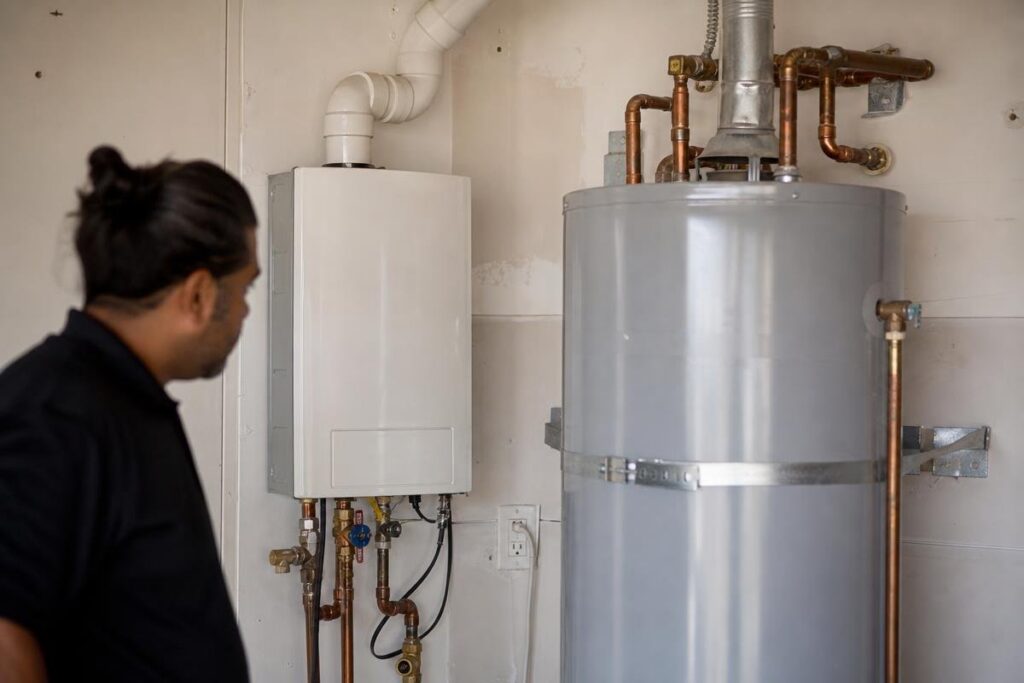
Trying to decide between a tankless vs. tank water heater for your Phoenix home? It’s one of the most common questions our plumbing team hears, and the right answer depends on more than just price. Phoenix’s notoriously hard water, extreme summer heat, and older home infrastructure all play a role in which system will actually serve you well long-term. Penguin Air, Plumbing & Electrical has been helping Valley homeowners make this call since 2011, and as a company licensed by the Arizona Registrar of Contractors, we’ll walk you through exactly what to consider before you buy.
Not sure which water heater is right for your home? Our team can help you figure it out fast. Call us at (480) 525-5400.
Key Takeaways
- Phoenix’s hard water (16-20 grains per gallon) accelerates scale buildup in both tank and tankless water heaters faster than most U.S. cities.
- Tankless water heaters run more efficiently in Phoenix because incoming water is already 70-80°F in summer, improving output and reducing workload.
- Older Phoenix homes may need gas line or electrical panel upgrades before a tankless unit can be safely installed.
- Tank water heaters stored in unconditioned garages face extra wear from Phoenix’s extreme heat, shortening their lifespan.
- The tankless vs. tank water heater decision comes down to your home’s age, water usage, and budget for upfront installation costs.
Why This Choice Is Different in the Desert
The reason this decision plays out differently here than it would in, say, Minnesota comes down to three local realities. Valley water averages 16 to 20 grains per gallon in hardness, which is among the highest in the country, and that scale buildup punishes both tank and tankless units. Layer on 110-plus-degree summers, garage temps that can push 130 degrees, and larger multi-bathroom homes with high hot-water demand, and you have conditions that make this call more serious than just comparing price tags.
If your water heater is already struggling, check out why your water might not be heating up before reading further. This guide covers how each type works, real costs, climate performance, and a clear decision framework built for Phoenix homes.
How Each Type of Water Heater Actually Works
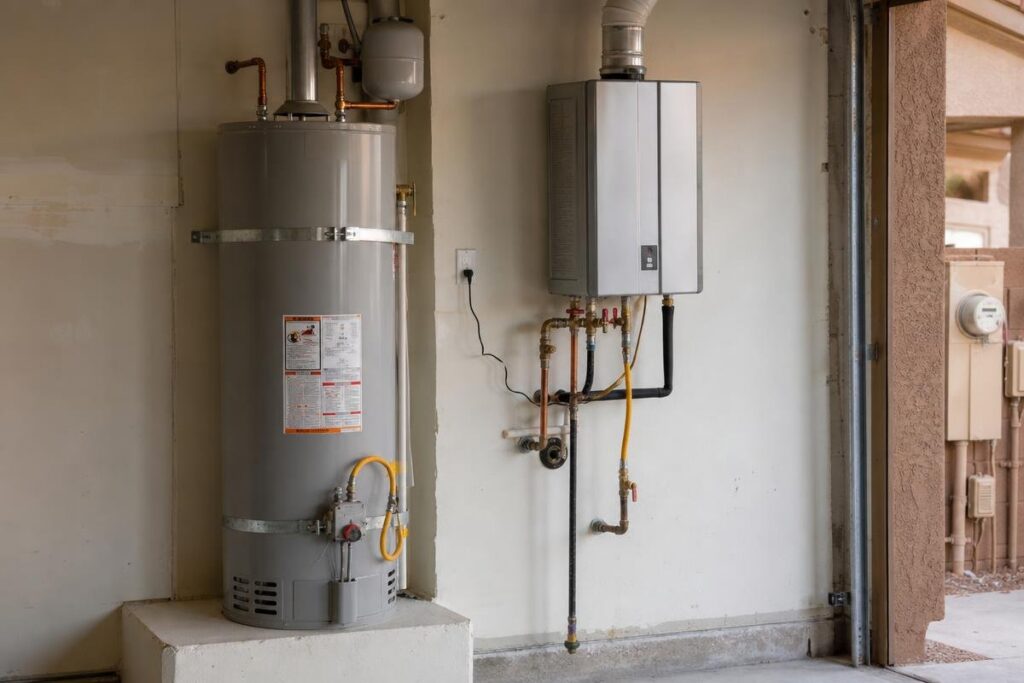
How a Storage Tank Water Heater Works
A storage tank water heater stores 40 to 80 gallons of pre-heated water and keeps it hot around the clock using a gas burner or electric element. That constant reheating is called standby heat loss, and it costs you money even when no one is home. Most units hold water at your set temperature, usually around 120 degrees F.
Tank units come in a range of sizes. Here is a simple guide for Valley households:
- 40 gallons for 1 to 2 people
- 50 gallons for 3 to 4 people
- 80 gallons for 5 or more people, or homes with large soaking tubs
Most homes in the Chandler and Gilbert areas run natural gas tank models. Electric tank units are available too, but gas tends to recover faster after heavy use.
Because Phoenix households often run larger than the national average, with more bathrooms and more occupants, tank sizing here skews toward the upper end. An undersized tank is usually the first thing to check when the hot water runs out before everyone’s had a shower.
How a Tankless Water Heater Works
A tankless water heater heats water on demand only when you open a tap, with no stored reservoir and no standby heat loss. Cold water flows through a heat exchanger, a burner fires instantly, and hot water comes out in a continuous stream. The moment you turn off the tap, the burner shuts down.
Flow rate is the key spec to know:
- Whole-home gas tankless units deliver 7 to 10 gallons per minute, enough for 2 to 3 fixtures running at the same time
- Electric tankless units top out at 3 to 5 gallons per minute, better suited for a single point of use than a full Goodyear or Buckeye household
One advantage specific to our area: Phoenix’s incoming water supply reaches 70 to 80 degrees F in summer. That warmer starting temperature means a tankless unit does not have to work as hard, which improves its effective output during peak-demand months. If a tankless unit ever stops delivering, our guide on water heater trouble signs can help you figure out what is going on.
Upfront Cost vs. Long-Term Savings: The Real Numbers
Purchase Price and Installation Costs
The price gap between tank and tankless is real. The ranges below reflect current pricing from our team based on recent installations across the Phoenix metro.
- Storage tank (gas, 40-50 gal): $600 to $1,400 installed
- Storage tank (electric): $500 to $1,100 installed
- Tankless gas (whole-home): $1,300 to $3,300 installed
- Tankless electric (whole-home): $800 to $2,000 installed
Those tankless install ranges can feel wide. The reason is simple. Older homes in areas like Maryvale, Laveen, and Avondale often have undersized gas lines or older electrical panels that need upgrading before a tankless unit can run properly. If your home needs a panel or gas line upgrade, budget toward the top of that range.
Monthly Operating Costs in the Phoenix Metro Area
This is where tankless starts earning back its premium. The DOE estimates tankless units run 24 to 34 percent more efficiently for households using 41 gallons or less per day. For higher-use homes, that efficiency advantage drops to 8 to 14 percent. With APS and SRP electric rates averaging roughly $0.12 to $0.14 per kWh, a typical Valley household saves $80 to $150 per year switching from a gas tank to a gas tankless unit.
One local factor works in your favor here. Our incoming cold water reaches 70 to 80 degrees in summer, so tankless units do not have to work as hard to hit your target temperature. That improves real-world efficiency compared to what you would see in colder states. Hard water is the offset. At 16 to 20 grains per gallon, scale builds fast in both types, cutting efficiency over time. Staying on top of routine water heater maintenance protects that efficiency either way.
How Long Until a Tankless Unit Pays for Itself?
Run the math on a typical gas tankless installation that costs $1,000 more than a comparable tank unit. At $100 to $150 in annual savings, you break even in roughly 7 to 10 years. A gas tankless lasts 20-plus years. A storage tank averages 8 to 12. Over a 20-year horizon, total cost of ownership clearly favors tankless.
One honest caveat: if you plan to move within 3 to 5 years, you may not recoup the premium before you sell. In that case, a quality tank replacement is the smarter short-term call.
Get a free water heater estimate from our team. We’ll assess your gas line and electrical panel during the same visit, so your quote reflects the real cost of your home, not a generic guess.
What Phoenix’s Climate and Hard Water Do to Your Water Heater
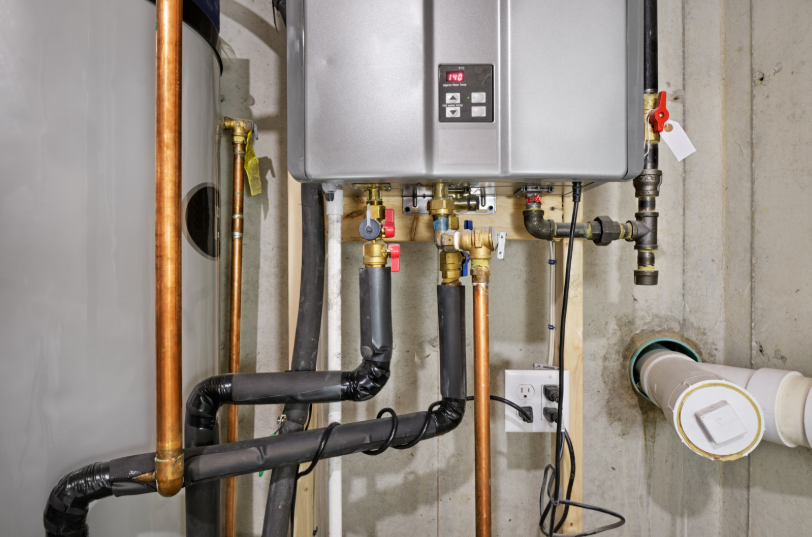
No generic water heater comparison covers what Valley homeowners actually deal with. The water coming out of your tap in Chandler, Gilbert, or Goodyear is some of the hardest in the country. Pair that with garage temperatures that could bake a casserole, and your water heater is fighting battles most units were never designed for.
Hard Water Scale: Phoenix’s Biggest Water Heater Killer
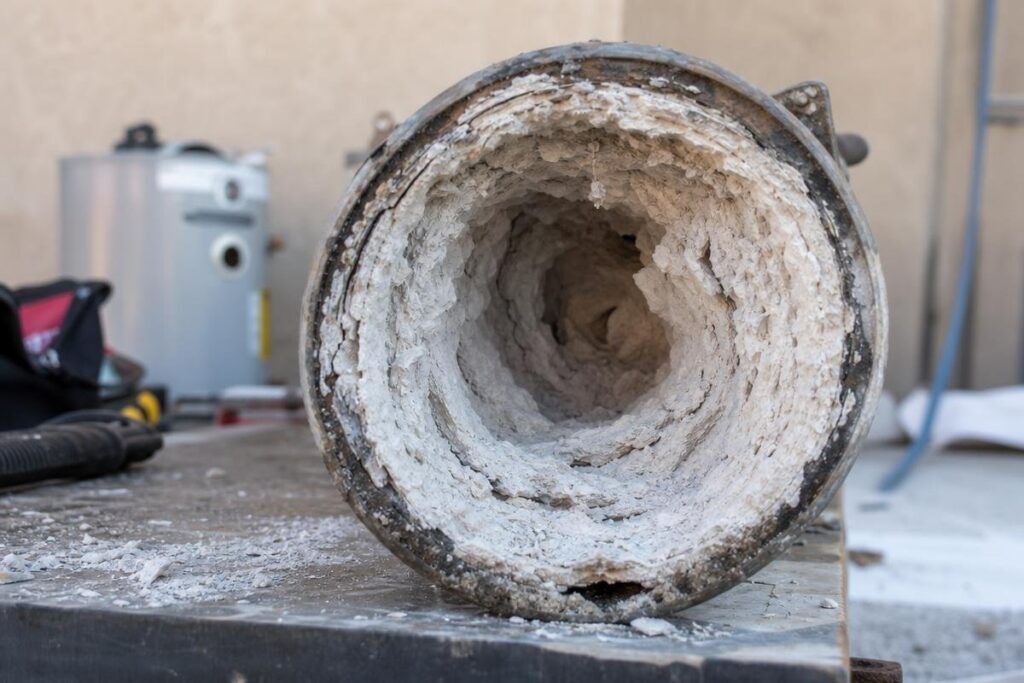
Municipal water across the Phoenix metro averages 16 to 20 grains per gallon of dissolved calcium and magnesium. That puts us consistently among the hardest water supplies in the country. Scale builds fast here, faster than most homeowners expect.
In a storage tank, minerals settle on the tank floor and coat the heating element. That layer of scale acts like insulation, forcing the unit to run longer and hotter just to heat the same amount of water. You hear it as that popping or rumbling noise from the tank. That sound means efficiency is already dropping.
Tankless units are actually more sensitive to scale damage. Mineral deposits build up inside the heat exchanger and restrict water flow. Rinnai and Navien units will throw flow-rate error codes once scale reduces GPM output by 15 to 20 percent. Some manufacturers also require a whole-home water softener to keep the warranty valid. If you are wondering why your hot water suddenly feels weak or inconsistent, scale in the heat exchanger is often the reason.
How Desert Heat Affects Tank and Tankless Units Differently
Summer ambient temps in the Valley regularly top 110 degrees F. Inside an unconditioned garage in Buckeye or Laveen, temps can hit 130 to 140 degrees. That extreme heat accelerates corrosion in storage tanks and burns through anode rods much faster than the manufacturer’s schedule assumes.
Tankless units handle high ambient temps better. There is no standing water sitting in a hot enclosure all day, so there is less corrosion risk from heat alone. One upside for both types: incoming cold water here reaches 70 to 80 degrees F in summer, compared to 40 to 50 degrees in northern states. Both units need less energy to hit 120 degrees during summer months, which does help offset some of the hard water efficiency losses.
Performance Showdown: Hot Water Supply, Recovery, and Simultaneous Use
Will a tankless unit actually keep up when your family is running two showers, the dishwasher, and a bathroom faucet all at once? For most Chandler and Gilbert homes, the answer is yes, but only if the unit is sized correctly.
Can a Tankless Unit Keep Up With a Busy Phoenix Household?
A properly sized whole-home gas tankless unit rated at 7 to 10 GPM can handle a shower (2 to 2.5 GPM), a dishwasher (1 to 2 GPM), and a bathroom faucet (1 to 1.5 GPM) running at the same time without breaking a sweat. The key word there is sized correctly.
Undersizing is the most common mistake we see during installations. Homes in Scottsdale and Goodyear with three or more bathrooms need a unit rated at 9 to 10 GPM with a minimum 199,000 BTU input. Go smaller and you will feel it on a busy morning.
One local advantage worth knowing: incoming water in the Glendale and Avondale area hits 70 to 80 degrees in summer, which improves your effective GPM output during peak months. Winter lows in the mid-30s do cool that incoming supply slightly, so we always size for the coldest month, not the average.
When a Storage Tank Might Actually Win
There are three situations where a tank water heater is the smarter call:
- Large soaking tubs over 80 gallons, where a tank fills faster than a tankless flow rate allows
- Homes with four or more bathrooms all running simultaneously, where a single tankless unit may struggle to keep pace
- Same-day replacements on a tight budget, where a tank is faster and cheaper to swap out
Need a same-day swap? Our team can typically get a storage tank installed the same day you call at (480) 525-5400.
Lifespan, Maintenance, and What Breaks First
Expected Lifespan of Each Type in Phoenix
Storage tank water heaters last 8 to 12 years in the Phoenix metro. That is shorter than the national average of 10 to 15 years. Hard water here depletes anode rods faster, which leads to tank corrosion. Once the anode rod is gone, the tank itself starts to rust from the inside out. If you notice rust-colored water or pooling around the base, read our guide on what to do when your water heater starts leaking before it causes real damage.
Tankless units last 15 to 20 years or more. That longer lifespan is a real advantage, but only if you keep up with maintenance. Skip it here in the Valley, and you will shorten that window significantly.
Garage installs are especially hard on tank units. Garage temperatures in Goodyear and Buckeye can hit 130 to 140 degrees in summer. That heat stresses the anode rod and speeds up corrosion in ways most homeowners never see coming.
Routine Maintenance Your Water Heater Needs Here
Phoenix’s hard water makes annual maintenance non-negotiable. This is not optional the way it might be in Flagstaff or Tucson. Our team sees both failure modes regularly, and skipping a single year of maintenance is often what tips a unit into early replacement.
Storage tank annual checklist:
- Flush the tank to clear sediment buildup
- Inspect and replace the anode rod every 3 to 5 years, sooner in hard water
- Test the TPR (temperature and pressure relief) valve
- Confirm thermostat is set to 120 degrees
Tankless annual checklist:
- Descale the heat exchanger with white vinegar or a commercial descaler kit
- Clean the inlet filter screen every 6 to 12 months
- Inspect venting for blockages, especially after monsoon season debris can block venting and cut off hot water entirely
- Check the display panel for error codes (Rinnai and Navien units log fault history)
Igniter failure and flow sensor failure are the most common tankless repair calls we see in Laveen and Avondale. Both are usually preventable with regular upkeep.
So Which One Is Right for Your Phoenix Home? A Simple Decision Framework
You’ve read the comparisons. Now here’s a straight answer. Your situation points pretty clearly to one option once you know what to look for.
Choose a Tankless Unit If…
- You plan to stay in the home 10 or more years
- You have 2 to 3 bathrooms with moderate simultaneous demand
- You already have a whole-home water softener or plan to install one
- You want to free up garage space
- Your home has natural gas service and an adequate gas line
- You’re upgrading, not just doing a quick replacement
Tankless is the best water heater choice for most Valley homes where the long-term math works out. If you’re weighing fuel types, comparing gas and electric water heater options for your home can help narrow it down further.
Stick With a Storage Tank If…
- You need a same-day replacement with no delays
- You have 4 or more bathrooms or a large soaking tub
- A gas line or electrical panel upgrade would add significant cost
- You plan to sell the home within 3 to 5 years
- Budget is tight right now
Older homes in areas like Maryvale or Laveen often have undersized gas lines. A tank swap keeps costs predictable.
One More Option Worth Knowing About
Hybrid heat pump water heaters pull warm air from the surrounding space and use it to heat water. They are 2 to 3 times more efficient than a standard electric tank and can cut your water heating costs by 60 to 70 percent.
A typical Goodyear or Avondale garage easily meets the 1,000 cubic foot minimum these units need. Valley heat works in your favor here year-round. Installed cost runs roughly $1,000 to $1,800, and they qualify for federal tax credits under the Inflation Reduction Act. For a tankless water heater installation in the Phoenix Metro Area, or any of these three options, our team can walk you through exactly what fits your home.
Why Phoenix Homeowners Trust Us for Water Heater Work
Our team at Penguin Air, Plumbing & Electrical has been doing this work since 2011, founded by Arizona natives who have spent decades inside Valley homes. We are licensed by the Arizona Registrar of Contractors, and we know what hard water does to a heat exchanger. We know what a 130-degree garage does to an anode rod. That local knowledge matters when you are deciding between a tankless and a tank unit.
We hold a BBB A+ Rating and BBB Accreditation since 2011, along with the Business Ethics Award. Our flat-rate pricing means you see the full cost before any work begins, no surprises after the job is done. If your water heater fails today, we have same-day availability to get your hot water back fast.
Homeowners across the Valley from Ahwatukee to Deer Valley, and in cities like Glendale and Scottsdale, have left us over 6,400 reviews averaging 4.7 out of 5 stars. They mention technicians like Cade, Garrett, and Jason explaining every step clearly and diagnosing problems on the first visit. If you are not sure why your water is not heating up, that is exactly the kind of call our team handles every day.
We are centrally located at 3710 East University Dr Suite 1, Phoenix, AZ 85034, which puts us close to every corner of the metro. Whether you need a tankless water heater installation or a full water heater replacement, our team is ready.
Frequently Asked Questions
How long does a tankless water heater last in the Valley?
With annual descaling and a whole-home water softener, a gas tankless unit typically lasts 15 to 20 years. Skip that maintenance in Goodyear or Glendale and a hard water scale can cut that down to 8 to 12 years.
Is a tankless water heater worth it for my home?
For most homeowners planning to stay 10 or more years, yes. The math gets tighter if your home needs gas line or electrical upgrades before installation, or if you run multiple showers and appliances at the same time constantly.
What size tankless unit do I need for a 3-bedroom home?
A 3-bedroom, 2-bathroom home typically needs a gas unit rated at 7 to 9 GPM with at least 150,000 to 180,000 BTU. Size up to 9 to 10 GPM for 3 bathrooms or a large soaking tub. Always size for the coldest month, not summer.
How does hard water affect my water heater?
Phoenix metro water averages 16 to 20 grains per gallon, among the highest in the country. Annual flushing helps, and understanding whether a water softener makes sense for your home is a smart next step before scale causes real damage.
What does water heater installation cost?
A gas tank replacement typically runs $600 to $1,400 installed. A whole-home gas tankless installation runs $1,300 to $3,300. We use flat-rate pricing, so you know the full number before work begins.
Can I switch from tank to tankless the same day?
A like-for-like tank swap can often happen same-day. Switching to tankless typically takes 4 to 6 hours and may require gas line or venting work. Our team gives you a realistic timeline during the estimate, before anything is touched.
Ready to stop guessing and get a straight answer for your home? Call our team at (480) 525-5400 or schedule online. We serve neighborhoods from Ahwatukee to Deer Valley and the surrounding Valley cities. You will know the full price before we touch anything.
Ready to Get Started with Penguin Air, Plumbing & Electrical?
Call (480) 525-5400 to speak with our team directly. We’re ready to answer your questions, walk you through your options, and help you find the right solution for your needs. Whether you’re just starting to plan or ready to move forward, we’ll make the process simple and stress-free.
Ready to move forward? Schedule your water heater installation today and we’ll confirm the full flat-rate price before any work begins.